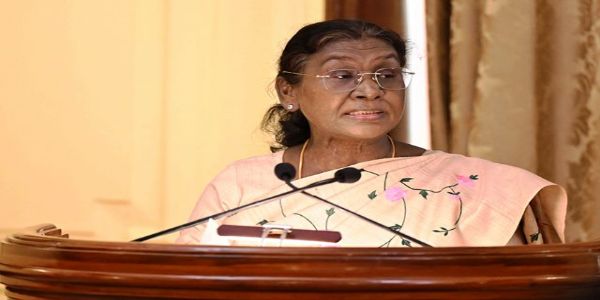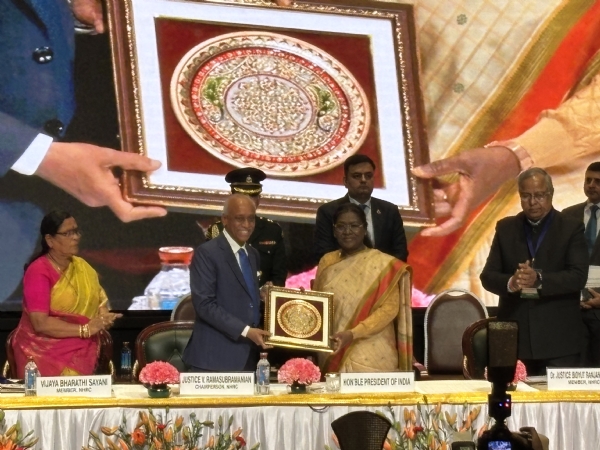
New Delhi, 10 December (H.S.): President Droupadi Murmu on Wednesday asserted that the dignity and rights of every citizen are non-negotiable, emphasizing that India’s cultural ethos, rooted in the ancient philosophy of Vasudhaiva Kutumbakam (“the world is one family”), reinforces the spirit of universal human rights.She was addressing the National Human Rights Day celebration held in New Delhi, which was attended by Justice V. Ramasubramanian, Chairperson of the National Human Rights Commission (NHRC), Commission Members Justice Bidyut Ranjan Sarangi and Vijaya Bharati Sayani, Principal Secretary to the Prime Minister P.K. Mishra, and Arati Sianni, UN Resident Coordinator in India, among other dignitaries.
During the event, President Murmu released the 2024–25 editions of the NHRC’s Hindi journal Nai Dishayen and its English counterpart Journal of the NHRC. She noted that India had played a pivotal role in drafting the Universal Declaration of Human Rights and that its guiding principles of dignity, equality, and freedom are deeply woven into India’s cultural fabric.
Highlighting Dr. B.R. Ambedkar’s vision, the President said the architect of the Constitution viewed human rights, democracy, and social justice as inseparable ideals. She commended the NHRC for its proactive approach, stating that the Commission has taken suo motu action in over 3,000 cases, paying special attention to the rights of Scheduled Castes, Scheduled Tribes, women, children, senior citizens, and persons with disabilities.
She stressed that India’s vision of a Developed Bharat by 2047 can only be realized when the benefits of progress reach the last person in society. “Human rights and development are deeply intertwined,” she said, adding that access to quality education, healthcare, housing, clean water, sanitation, and social security forms the backbone of human rights fulfillment.
The President lauded initiatives such as Eklavya Model Residential Schools and PM SHRI Schools for providing quality education to children from marginalized communities, and cited housing and food security schemes that have empowered millions to lead dignified lives. She further noted that recent labour reforms and expanded social security provisions have strengthened workers’ rights.
Underscoring the government’s commitment to inclusive growth, Murmu concluded that ensuring essential services reach citizens in remote and border areas is a collective responsibility of both the state and society. “True development,” she said, “means no one is left behind in the nation’s journey toward progress.”
---------------
Hindusthan Samachar / Jun Sarkar

10 Dec 2025