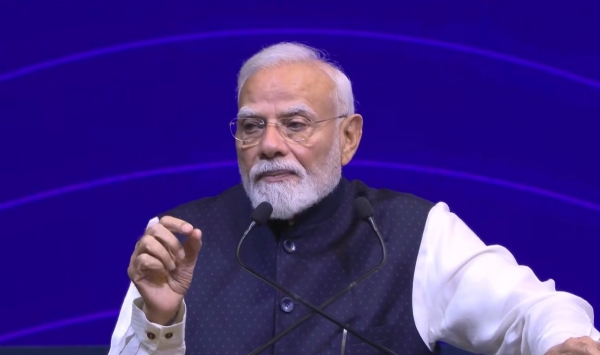
Delhi, 17 September (H.S.): Prime Minister Narendra Modi said on Thursday that the world was increasingly recognising the need for new and trusted locations for semiconductor manufacturing, and that India was continuously preparing itself to seize this opportunity. He said India was taking all necessary steps to emerge as a preferred destination for semiconductor manufacturing.
Inaugurating Semicon India-2026 at Yashobhoomi here, the Prime Minister said India had already embarked on the second phase of the India Semiconductor Mission. He said the first phase had envisaged an outlay of around $8 billion, which had been increased to $13.5 billion in the second phase. He said the initial phase focused on policy deliberations, while subsequent phases witnessed progress towards pilot production lines and testing, and India had now reached the stage of commercial production.
Modi said commercial production had commenced at two semiconductor plants in Mohali and Surat, and chips manufactured in India were now reaching customers both within the country and across the world. He said taking a country to this stage in the semiconductor sector was no easy task, as setting up a factory did not automatically translate into the commencement of production. Developing the requisite technological capabilities and expertise takes considerable time. The Prime Minister called upon industry to continue playing an active role in this journey.
He said India’s objective was to foster the growth of fabless companies and promote the creation of intellectual property within the country. Emphasis was also being placed on developing technologies for various types of compound semiconductors, silicon photonics and the infrastructure required for artificial intelligence-based applications. Modi said strengthening the semiconductor supply chain remained one of India’s key priorities and several reforms had been undertaken in this direction.
The Prime Minister said 12 semiconductor projects had so far been approved and their scope would be expanded further in the next phase. He also urged companies operating in areas linked to the semiconductor supply chain, including chemicals and gases, to take advantage of the opportunities available in India.
PM Modi said one of India’s major strengths was its young and skilled human-resource base. The government’s objective is to train 100,000 engineering students for the semiconductor industry, and a large number of young people have already received training. He also called upon young Indian talent conducting research in India, as well as Indians engaged in research abroad, to connect with the country in developing advanced technologies. The Prime Minister urged industry leaders to take the lead in research and development (R&D) in India, saying this would benefit industry while also strengthening the country’s young talent pool.
He said that as artificial intelligence expands, the demand for computing power would increase rapidly, accompanied by a rise in electricity requirements. Thousands of high-performance processors are operating simultaneously in AI data centres and processing vast quantities of data. In this context, ensuring reliable power supplies to semiconductor plants and data centres would also be crucial. Modi said India was investing on a large scale in the power sector. Over the past decade, the country’s installed solar power capacity had risen to more than 160 GW. Work was also progressing rapidly in the nuclear power sector, with a focus on small modular reactors. He added that India had also expanded its electricity transmission network.
The Prime Minister said India’s democratic system, vast talent pool and steadily strengthening infrastructure provided it with an opportunity to play a significant role in the global semiconductor supply chain. He said that at a time when global supply chains were undergoing transformation, the opportunities emerging in India needed to be viewed from a broader global perspective. He noted that Semicon India was launched in 2022 and that with each edition, India’s semiconductor journey had entered a new phase. This year’s event, he said, reflected India’s progress beyond pilot projects and towards commercial production.
---------------
Hindusthan Samachar / Jun Sarkar

18 Aug 2026