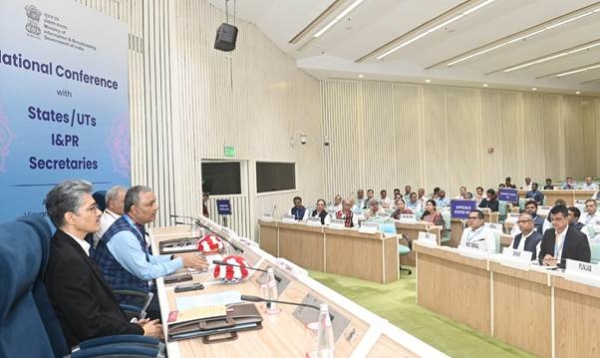
New Delhi, Aug 25 (HS): The Centre and States have begun working on a more coordinated approach to India's growing media and creative economy, with senior Information and Public Relations officials meeting in New Delhi on Tuesday to discuss everything from film permissions and broadcasting to digital content, live events and market access for creators.
The Ministry of Information and Broadcasting held a national conference with Information and Public Relations Secretaries of States and Union Territories, seeking closer coordination between the Centre and state governments in areas connected with media, public communication and the creative economy.
Secretary, Information and Broadcasting, Chanchal Kumar, chaired the meeting.
The discussions come as the government increasingly looks at the creative sector not only as a cultural industry but also as a source of jobs, investment and international influence.
At the meeting, the Ministry stressed that States would need to build their own creative ecosystems rather than follow a single national model. Regional talent, local cultural strengths and existing institutional capacity were identified as areas that could be developed further.
A major part of the discussion centred on WAVES 2027, along with platforms such as WAVES Bazaar, WaveX and the Create in India Challenges. The government sees these platforms as potential routes through which creators and start-ups from different parts of the country can reach investors, markets and international partners.
The conference also looked at some of the practical hurdles facing the media and entertainment industry.
These included the implementation of the Right of Way mechanism for cable operators, improving the system for film-shooting permissions and expanding the use of the Indian Cine Hub single-window platform for films and live events.
For the live-events industry, a simpler permission system could be particularly important as concerts, cultural programmes and other large public events expand across Indian cities.
The Ministry also discussed strengthening public-service broadcasting through greater content collaboration with States, including State-specific programming and wider public outreach through Doordarshan and Akashvani.
Another area under discussion was the development of digital and user-generated content on the Waves OTT platform, along with closer integration between the Indian Cine Hub and Film Facilitation Office portals.
The Centre also wants greater coordination between PIB's regional offices, State Information and Public Relations Departments and regional units of Doordarshan and Akashvani so that public communication can be better adapted to local audiences.
For State governments, the meeting also brought attention to capacity building. Officials discussed training DIPR personnel through the Indian Institute of Mass Communication and the transition to the digital framework under the Press and Registration of Periodicals Act, 2023 through the Press Sewa Portal.
The conference also covered the supply of books to State governments under the Samagra Shiksha framework and other public outreach initiatives.
The larger message from the meeting was that India's media and creative economy cannot be developed entirely from Delhi. Much of the country's cultural production, regional media, talent and live-event activity is rooted in the States.
The Centre's challenge will now be to turn the discussions into workable systems at the State level, particularly in areas such as permissions, infrastructure, training and market access.
The Ministry said States and Union Territories expressed willingness to work more closely with it and participate in strengthening what it described as the Orange Economy.
For India's creators and media businesses, the significance of Tuesday's meeting will ultimately depend on what changes on the ground — whether permissions become easier, regional talent gets better access to markets and investment, and whether State-level creative industries receive the infrastructure and support needed to grow.
---------------
Hindusthan Samachar / Indrani Sarkar
18 Aug 2026