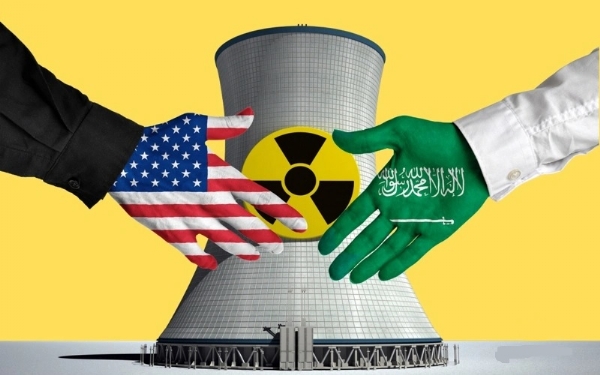
Washington, 24 July (H.S.): The White House has announced a new condition for finalising the landmark nuclear cooperation agreement between the United States and Saudi Arabia, stating that the deal can move forward only if Riyadh joins the Abraham Accords and establishes diplomatic relations with Israel.
According to Russia Today (RT), White House Press Secretary Karoline Leavitt said that US President Donald Trump’s administration views the agreement as being linked to Saudi Arabia normalising ties with Israel. She said discussions with Saudi leaders are continuing and Washington hopes Riyadh will become part of the Abraham Accords in the near future.
The condition was not publicly mentioned when the United States and Saudi Arabia announced the nuclear cooperation agreement on Wednesday. Saudi Arabia, however, has previously maintained that it will not formally recognise Israel until there is meaningful progress towards the establishment of a Palestinian state.
According to the US Department of Energy, Energy Secretary Chris Wright and Saudi Energy Minister Prince Abdulaziz bin Salman signed agreements related to the so-called “123 Nuclear Agreement” and additional nuclear security arrangements. The deal would allow Saudi Arabia to develop a civilian nuclear energy programme with American technology and expertise and potentially establish nuclear reactors in the future.
Reports suggest that the agreement could also allow Saudi Arabia to pursue domestic uranium enrichment capabilities. However, the deal does not make the International Atomic Energy Agency’s (IAEA) Additional Protocol mandatory. The protocol provides international inspectors with expanded authority to detect undeclared nuclear activities.
The provision has raised concerns among nuclear non-proliferation experts and several US lawmakers. Critics argue that allowing Saudi Arabia to enrich uranium could create risks if such technology is later diverted towards developing nuclear weapons. They warn that this could trigger a new nuclear arms competition in the Middle East.
Saudi Crown Prince Mohammed bin Salman has previously stated that if Iran acquires nuclear weapons, Saudi Arabia would consider taking similar steps.
The agreement could open opportunities for American companies to invest billions of dollars in Saudi Arabia’s nuclear energy sector. However, under the US Atomic Energy Act, the agreement must undergo review and approval by the US Congress before it can take effect.
Experts believe blocking the agreement through Congress could be difficult, as overturning a presidential veto would require a two-thirds majority vote in both the House of Representatives and the Senate.
The proposed nuclear partnership has become a major component of broader US-Saudi strategic relations, while also raising diplomatic and security questions over regional stability, nuclear safeguards and the future of Saudi-Israeli relations.
---------------
Hindusthan Samachar / Jun Sarkar
24 Jul 2026
Iran Warns Trump Over Use of Frozen Assets, Says Move Could Set Dangerous Global Precedent
24 Jul 2026