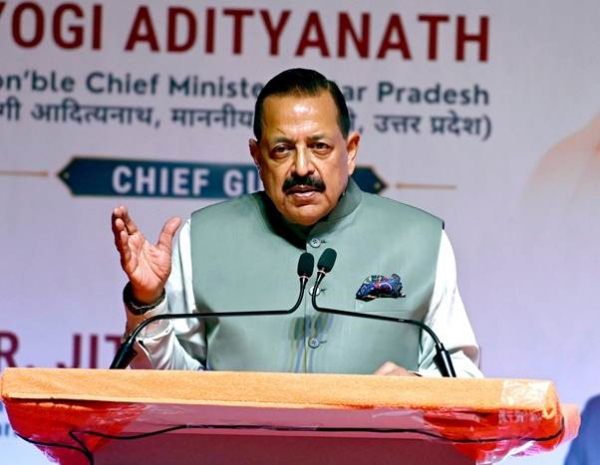
Lucknow, 08 June (HS): Dr.Jitendra Singh, Union Minister of
State (Independent Charge) for Science and Technology and Earth Sciences,
opened the new Regional Meteorological Centre (RMC) in Lucknow today with Uttar
Pradesh Chief Minister Yogi Adityanath. On occasion, the Minister stated that
India's meteorological infrastructure has expanded in unprecedented ways over
the previous decade, allowing for more accurate, location-specific, and impact-based
weather forecasting services across the country.
Dr. Jitendra Singh, who spoke at the event, stated that advances in weather
forecasting and observation systems over the previous decade have
revolutionized how meteorological services are supplied to residents, disaster
management agencies, farmers, visitors, and the aviation sector. According to
the Minister, India has just 17 Doppler Weather Radars in 2014, with numerous
states without even one radar, including Jammu and Kashmir, Punjab, and Uttarakhand.
He told the gathering that the network has already grown to
50 Doppler Weather Radars, with another 50 radars projected under Mission
Mausam, bringing the total to over 100 radars over the next two years. He
stated that this extension will considerably enhance real-time weather
monitoring and forecasting skills across the country.
Dr.Jitendra Singh highlighted developments in forecasting services, noting that
weather forecasting has progressed from broad regional projections to highly
localized and time-specific forecasts. He stated that individuals now have
access to precise short-term forecasts, such as weather conditions for the next
several hours, allowing for greater planning and preparation. The Minister
emphasized that increased public trust in weather predictions is a result of
significant advancements in observational networks, forecasting models, and
distribution platforms.
Dr. Jitendra Singh, speaking especially about Uttar Pradesh,
stated that the state's geographical variety and climatic unpredictability make
it one of the most significant areas for sophisticated meteorological services.
He stated that Uttar Pradesh is extremely prone to floods, droughts, heatwaves,
thunderstorms, and other extreme weather occurrences, hence accurate
forecasting and warning systems are vital for public safety and disaster
preparation.
The Minister emphasized the significant improvement in meteorological
infrastructure in Uttar Pradesh over the previous decade. He stated that
whereas the state only had one Doppler Weather Radar in 2014, three are
currently operating, with many more being built. The number of automatic
weather stations in the state rose from 59 to 107, automatic rain gauge
stations from 132 to 140, and lightning sensors from 0 to 7.
He also mentioned that aviation meteorological services are
now available at eleven airports around Uttar Pradesh, demonstrating the
state's developing aviation infrastructure. Dr. Jitendra Singh also emphasized
the considerable increase of meteorological services in Uttarakhand. He added
that, despite its vulnerability to flash floods, cloudbursts, landslides, and
avalanches, the state historically lacked Doppler weather radar. Three of these
radars have already been deployed, and more are planned as part of Mission Mausam.
The number of automatic weather stations, airport meteorological observatories,
and lightning detection systems has also expanded significantly, improving
weather monitoring capacities throughout the Himalayan area. The Minister emphasised the importance of the
newly established Regional Meteorological Centre in Lucknow, saying it will
play a critical role in decentralising meteorological services and enhancing
regional forecasting capability.
He stated that the Centre will serve Uttar Pradesh,
Uttarakhand, and neighboring regions, allowing for more targeted monitoring,
forecasting, and sharing of meteorological information. He also stated that
plans are in the works to construct specialized infrastructure, such as
sophisticated Doppler Weather Radars and wind profiler systems, with State
Government backing. Dr. Jitendra Singh stated that enhanced forecasting methods
are greatly reducing catastrophe risk by giving early warnings for flash
floods, cloudbursts, thunderstorms, lightning, avalanches, and other extreme
weather phenomena. He emphasized that, while forecasting accuracy has
significantly increased, the final success of weather services is dependent on
prompt action by local governments and public adherence to meteorological
agency recommendations and warnings.
The Minister urged individuals, local governments, and
disaster management organizations to fully utilize weather predictions and
early warnings, as well as impact-based alerts accessible on different digital
platforms. He stated that meteorological data is now reaching districts, local
governments, and Panchayats in real time and should be integrated into planning
and decision-making processes.
The establishment of the Regional Meteorological Centre in Lucknow is a key
milestone in the building of India's meteorological and climate services
infrastructure. The Center is anticipated to increase forecasting skills,
improve weather warnings distribution, and provide assistance to disaster
management, agriculture, aviation, and public safety throughout the region.
Hindusthan Samachar / Abhishek Awasthi
08 Jun 2026
Actress assault case:Judge rescuses himself from hearing survivors plea for fresh probe
Actress assault case:Judge rescuses himself from hearing survivors plea for fresh probe..