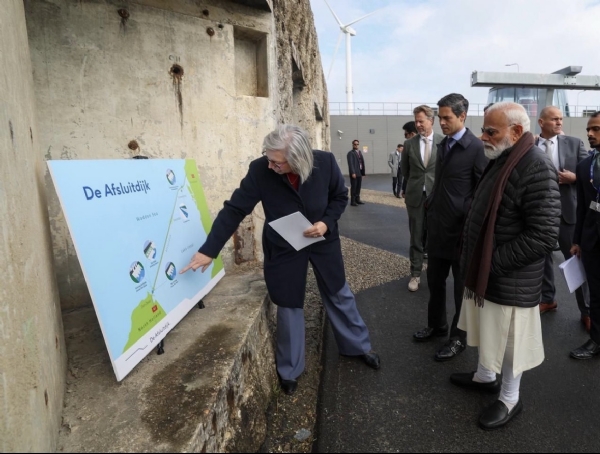
New Delhi, 17 May (H.S.): On the third day of his six-day, five-nation tour, Prime Minister Narendra Modi visited the historic Afsluitdijk Dam in the Netherlands along with Dutch Prime Minister Rob Jetten. During the visit, the two leaders reviewed projects related to water management, flood control, and the development of land and freshwater resources through the prevention of seawater intrusion.
Sharing details of the visit on social media platform X, Prime Minister Modi said that water resource management is an area in which the Netherlands has carried out pioneering work, and the entire world has much to learn from its expertise. He stated that he had the opportunity to understand the key features of the Afsluitdijk project and expressed gratitude to Prime Minister Rob Jetten for the detailed briefing.
The Prime Minister further said that India is actively promoting modern technologies aimed at improving irrigation systems, flood management, and the expansion of inland waterway networks. He added that cooperation between India and the Netherlands in the field of water management can be strengthened further.
Ministry of External Affairs spokesperson Randhir Jaiswal also described the visit as significant. In a post on X, he stated that Prime Minister Narendra Modi, along with Prime Minister Rob Jetten, visited the Afsluitdijk Dam, which stands as a symbol of Dutch engineering excellence and innovation in water management, flood protection, and freshwater storage.
He added that the visit is also important in the context of Gujarat’s Kalpasar Project, which aims to develop a massive freshwater reservoir and dam near the Gulf of Khambhat. The visit is expected to provide fresh momentum to India-Netherlands cooperation in the areas of climate adaptation, water technology, and sustainable infrastructure development.
Notably, the Afsluitdijk is one of the Netherlands’ most prominent dams and causeways, constructed between 1927 and 1932. The approximately 32-kilometre-long structure connects Den Oever in North Holland with the village of Zurich in Friesland province. The dam sealed off the saline Zuiderzee inlet from the North Sea, transforming it into the vast freshwater lake known as IJsselmeer.
The project is regarded as one of the Netherlands’ most significant achievements in water management and land reclamation. Following the construction of the Afsluitdijk, the threat of marine flooding was significantly reduced, while new opportunities emerged for agriculture, drinking water supply, and transportation. The dam also serves as a major road link between the northern and western regions of the country.
After the devastating North Sea flood of 1953, the height of the dam was increased in several phases. In 2019, an extensive modernization and reinforcement project was launched to strengthen the structure against challenges posed by sea storms and climate change.
---------------
Hindusthan Samachar / Jun Sarkar

18 May 2026