Kolkata, 24 March (H.S.) :
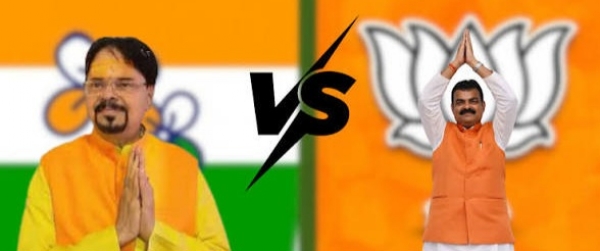
The politically significant Jorasanko Assembly constituency in central Kolkata is heading towards a keen contest in the 2026 West Bengal Assembly elections, with changing candidates and shifting electoral equations adding fresh uncertainty to the seat. The ruling All India Trinamool Congress (TMC), which has held the constituency for five consecutive terms, is expected to face a stiff challenge, particularly after dropping sitting MLA Vivek Gupta and fielding a new face, Vijay Upadhyay.
Political observers believe the denial of a ticket to Gupta reflects local dissatisfaction over his performance and an attempt by the party leadership to counter anti-incumbency sentiments.
Historically, Jorasanko has witnessed closely fought elections. The constituency was once considered a stronghold of the Indian National Congress, which won the seat 11 times. However, the political landscape began to change after Mamata Banerjee split from the Congress in 1998 to form the Trinamool Congress. Since 2001, the TMC has retained the seat, though often by narrow margins, indicating a fluid voter base.
In the 2021 Assembly election, Gupta defeated BJP candidate Meena Devi Purohit by a margin of 12,743 votes. However, concerns were raised subsequently over civic infrastructure, traffic management and issues affecting the trading community, which reportedly contributed to the decision to field a new candidate.
--------
Key candidates in the fray
The contest this time has become more interesting with three prominent candidates with business and social backgrounds entering the fray. The Bharatiya Janata Party (BJP) has nominated Vijay Ojha, considered a known face in the Burrabazar trading circuit with influence among non-Bengali business communities. The TMC’s nominee Vijay Upadhyay is known for his involvement in social initiatives and efforts to build grassroots connections in the constituency. Meanwhile, the Communist Party of India (Marxist) has fielded Bharat Ram Tiwari, a veteran Left worker aiming to revive the traditional support base of the Left Front.
Jorasanko’s social composition also makes the contest unique. A fully urban constituency, it is influenced by the commercial dynamics of Burrabazar, one of the country’s largest wholesale markets. The presence of a sizeable Marwari and Hindi-speaking trading population alongside Bengali middle-class families often makes the contest triangular. While the BJP is attempting to consolidate support among non-Bengali voters, the TMC is focusing on retaining its traditional Bengali and urban lower-income voter base. A marginal revival by the Left-Congress alliance could further complicate the contest.
Results from recent Lok Sabha elections also serve as a warning sign for the TMC. In the last three parliamentary elections, the BJP secured a lead over the TMC within this Assembly segment, highlighting a divergence in voting patterns between Assembly and parliamentary polls. If the BJP manages to replicate that trend, the contest could become significantly tighter.
Relatively low voter turnout has also contributed to the unpredictability of the seat. While turnout stood at 53.73 percent in 2016, it dropped to around 50 percent in 2021. Analysts say lower participation often results in tighter margins, where even small vote swings can alter the outcome.
--------
A constituency rich in heritage
Geographically and culturally, the constituency holds considerable importance. Located near key arteries such as Rabindra Sarani, Chittaranjan Avenue and College Street, the area remains a hub of commerce, education and cultural activity. Jorasanko is also known for its association with Nobel laureate Rabindranath Tagore, whose ancestral residence, Jorasanko Thakur Bari, remains a major cultural landmark.
As the 2026 Assembly elections approach, the Jorasanko contest is increasingly being seen as a prestige battle. For the TMC, it is a test of its urban dominance; for the BJP, an opportunity to expand its footprint in the heart of Kolkata; and for the Left, a chance to regain lost ground.
Overall, Jorasanko remains one of those constituencies where the personal credibility of candidates, local networks and community-based equations could outweigh broader party trends. With a sitting MLA denied renomination, new candidates in the fray and an unpredictable voter mood, the seat is expected to witness a closely fought contest that may go down to the last round of counting.
---------------
Hindusthan Samachar / Satya Prakash Singh