Beirut, Lebanon, 14 March (H.S.): Escalation in the GolanHezbollah’s leadership has publicly declared its readiness for a protracted, high‑intensity confrontation with Israel, as cross‑border bombardments tear into Lebanon’s roads, bridges, and vital facilities.
Hezbollah deputy secretary‑general Naim Qassem, in his second televised address since the latest regional war erupted, framed the conflict as “existential,” warning that Israel “will be surprised on the battlefield” if it persists.
The group’s escalation followed a joint US‑Israeli strike that, according to widely reported regional accounts, killed Iranian Supreme Leader Ayatollah Ali Khamenei, prompting Hezbollah to roll Raket and drone attacks into northern Israel and the occupied Golan.
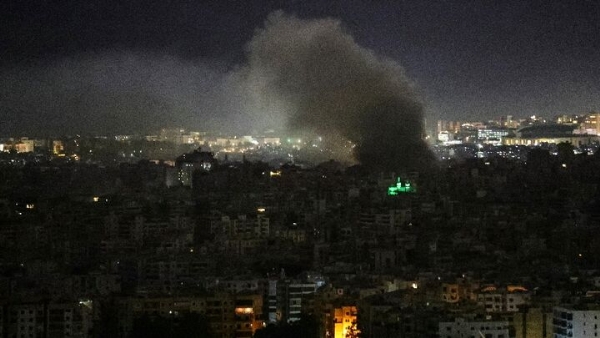
On Friday, Israel intensified pressure by destroying a key bridge over the Litani River between the southern Lebanese towns of Zrariyeh and Tayr Falsay, a move that Lebanese state media describe as the first Israeli strike on public infrastructure explicitly acknowledged since the war began.
The Israeli military characterised the bridge as a “key crossing” for Hezbollah logistics, used to move fighters and weapons between northern and southern Lebanon.
Israeli Defence Minister Israel Katz issued a stark warning that Lebanon’s civilian infrastructure would face an “increasing price” as long as Hezbollah continues to operate from its territory. He linked the destruction directly to Hezbollah’s presence, insisting that only “disarming Hezbollah” would end the damage.
Behind the strategic rhetoric lies a mounting civilian toll. In the southern village of Miyeh w Miyeh, near Sidon, Israeli airstrikes killed eight people in a single strike, according to Lebanon’s health ministry.
Mohammad Taqi, a bereaved father in the village of Irkey, buried four daughters—Zainab, Zahra, Malika, and Yasmina—aged between six and 13, who were killed along with five relatives in the same Israeli bombardment. Raw video from funerals circulated widely, with Taqi’s wounded face wrapped in bandages as he challenged the narrative of “targeting infrastructure.”
Additional strikes elsewhere left first responders exposed. In Sawaneh, a health ministry statement reported that two paramedics—one from the Hezbollah‑linked Islamic Health Committee and another from the Amal‑affiliated Risala Scouts—died in an Israeli strike. Early Saturday, a separate attack on a primary healthcare centre in Burj Qalawiya reportedly killed 12 doctors, paramedics, and nurses on duty.
UN Secretary‑General Antonio Guterres, visiting Beirut Friday, called on both Israel and Hezbollah to “stop the war” and move quickly toward a ceasefire.
Guterres announced a $325 million humanitarian appeal to support Lebanon as hundreds of thousands of civilians are displaced by airstrikes and forced evacuations, underlining the strain on already fragile state institutions.
Leaflets, Evacuation Warnings, and PropagandaIsraeli aircraft dropped propaganda leaflets over Beirut warning residents to “disarm Hezbollah” and to treat Lebanon’s direction as “your decision, not someone else’s.” One leaflet labelled Hezbollah as “Iran’s shield,” implicitly framing the conflict as a proxy war between Tel Aviv and Tehran.
At the same time, Israel expanded evacuation orders in southern Lebanon, effectively extending the “safe‑zone” more than 40 kilometres from the border and instructing civilians to leave areas Hezbollah uses to move weaponry from the Bekaa Valley to the south.
Despite the mounting pressure, Hezbollah has maintained that it is not only capable of enduring a long war but of dictating its tempo. The group launched fresh attacks on Friday as part of a so‑called “Quds Day operation,” timed to coincide with the Iran‑sponsored annual day of solidarity with Palestinians.
Analysts note that Hezbollah’s explicit readiness for a drawn‑out campaign signals a deliberate shift from previous limited‑conflict posture, while Israel’s focus on infrastructure and evacuation zones suggests a strategy aimed at both military attrition and demographic pressure on Hezbollah’s support base.
Underlying Dynamics:
The current round of violence is not simply a localized flare‑up; it is deeply interwoven with the wider US‑Iran conflict playing out across Iraq, the Gulf, and the Strait of Hormuz, where American KC‑135 refuelling aircraft have already been lost over western Iraq with all six crew members confirmed dead.
Even as the US insists that the tanker crash was not due to hostile or friendly fire, the broader environment has hardened both sides’ expectations of a “long battle” in the eastern Mediterranean arc, with Hezbollah and Israel now locked into a high‑stakes, mutually destructive spiral.
---------------
Hindusthan Samachar / Jun Sarkar

18 Aug 2026