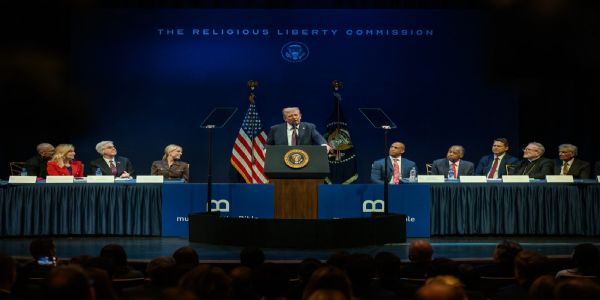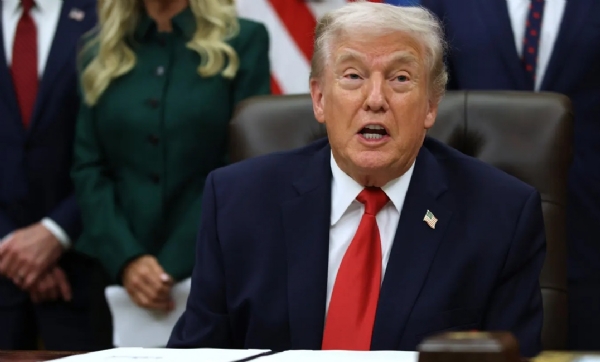
Washington, D.C. , 06 February (H.S.): U.S. President Donald Trump issued a chilling admonition to Iran’s Supreme Leader Ayatollah Ali Khamenei during a Wednesday interview with NBC News, declaring unequivocally that the Islamic Republic’s paramount cleric “should be very worried” as nuclear negotiations loomed in Oman, blending diplomatic overtures with unmistakable threats of reprisal.
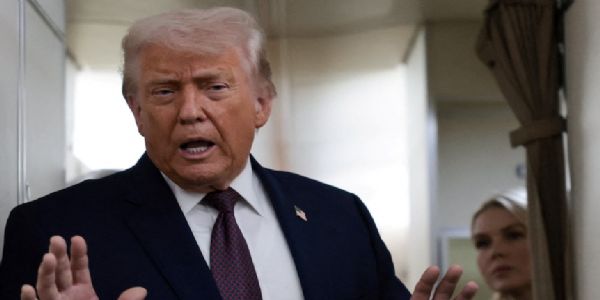
Responding to direct queries about Khamenei amid Tehran’s defiant posturing and recent protest suppressions, Trump underscored the administration’s fusion of coercion and dialogue, stating, “I would say he should be very worried, yeah. He should be,” in remarks relayed by CNN and contextualized by concurrent U.S. naval deployments to the Arabian Sea, including the USS Abraham Lincoln carrier strike group.
This rhetoric intensified just days after Iranian Foreign Minister Abbas Araghchi’s Thursday arrival in Muscat for Friday’s scheduled parleys with Trump envoy Steve Witkoff, where Washington demands curbs on uranium enrichment—allegedly nearing weapons-grade—alongside ballistic missile restraint and cessation of proxy funding to Hamas, Hezbollah, and Houthis.
Iran, conceding to bilateral formats after initial Turkish venue disputes, insists on sanctions relief as a nuclear-only precondition, per President Masoud Pezeshkian’s directive for “fair and equitable” engagement, while Armed Forces Chief of Staff Major General Abdolrahim Mousavi touted Wednesday upgrades to IRGC ballistic systems during a facility inspection, proclaiming a doctrinal shift to “offensive asymmetric warfare” post a purported “12-day war.”
U.S. Secretary of State Marco Rubio framed the agenda expansively—encompassing human rights divergences between regime and populace—while Vice President JD Vance highlighted Khamenei’s ultimate authority as complicating diplomacy, affirming Trump’s preference for non-military resolution yet readiness to strike if Tehran spurns a framework deal.
Oman’s mediation—pivotal since 2023 prisoner exchanges and June 2025 preliminary talks disrupted by U.S.-Israeli strikes on Iranian sites—facilitates indirect exchanges amid Arab lobbying that salvaged the summit from cancellation, as Qatar, Egypt, and UAE diplomats proffer principles targeting enrichment halts below 60% purity levels.
With U.S. forces intercepting an Iranian drone near the Lincoln and IRGC vessels shadowing tankers in Hormuz, Friday’s Muscat session at 10:00 AM local time (06:00 GMT) teeters on a precipice, where concessions could avert escalation or precipitate Trump’s vowed “negative outcomes.”
---------------
Hindusthan Samachar / Jun Sarkar

06 Feb 2026