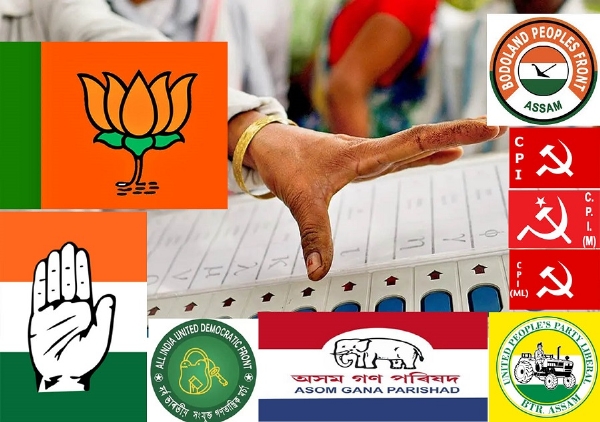
Kamrup (Assam), February 27 (HS): As the 16th Assam Legislative Assembly elections draw closer, political activities have intensified across the state, with the Palashbari Assembly constituency in lower Assam emerging as one of the most closely watched seats. Even before the official announcement of poll dates, the constituency has witnessed heightened political maneuvering, making the contest increasingly intriguing.
In the 29 No. Palashbari Assembly constituency, the ruling Bharatiya Janata Party (BJP) is facing internal competition over ticket allocation. Sitting MLA Hemanga Thakuria is reportedly facing local resentment and allegations of unfulfilled promises, though he remains hopeful of securing renomination. At the same time, young businessman Himanshu and youth leader Anup Medhi have stepped up their activities as potential contenders. Adding to the contest, Ayushmita Deka, daughter of former MP and current Governor Ramen Deka, along with Hajo MLA Suman Haripriya, have also begun groundwork in the constituency as probable BJP candidates.
The alliance dynamics between the BJP and the Asom Gana Parishad (AGP) have further complicated the scenario. Following constituency reorganization, former Chaygaon MLA Kamala Kalita is reportedly keen to contest from Palashbari, triggering a ticket tussle within the alliance. Dr. Kamala Kalita has publicly expressed determination to contest, particularly as Palashbari was once considered a stronghold of the AGP. Meanwhile, Chief Minister Dr. Himanta Biswa Sarma has indicated that if the contest between Himanshu and Hemanga Thakuria intensifies, the party may consider fielding a third candidate, with Ayushmita Deka being seen as a possible choice. Youth bodies have also voiced opposition to the idea of an “outsider” candidate, with adviser Bidyut Kalita actively engaging on the issue.
Opposition parties appear comparatively subdued. The Congress has shown limited visibility, with occasional posters of Munmi Dutta seen in the constituency, while earlier Nav Talukdar’s name had figured in discussions. The Asom Jatiya Parishad’s Pankaj Lochan Goswami, who had contested previously, is likely to re-enter the fray. The Trinamool Congress has also made its presence felt, with Bikash Medhi putting up posters and initiating outreach activities.
Delimitation has significantly altered the political landscape of the constituency. After reorganization, parts of Chaygaon and West Guwahati constituencies, including Six gràm panchayats, have been merged into Palashbari. Areas such as Rani and Sajanpara, with notable tribal populations, are now part of the constituency, leading to demographic shifts.
The Palashbari Assembly constituency currently has 2,15,489 voters. Among them, male voters number over 1.05 lakh, while female voters stand at over 1.10 lakh. The constituency comprises more than 28,000 Rabha voters, around 69,000 Koch-Rajbongshi voters, approximately 5,550 Bodo voters, about 11,500 Scheduled Caste voters, nearly 4,500 Bengali voters, around 2,000 Garo voters, about 2,500 Hindi-speaking voters and nearly 25,000 minority community voters.
With internal dissent within the ruling party, alliance-level seat negotiations, demographic changes post-delimitation and muted but visible opposition activity, Palashbari is shaping up as a high-stakes contest. As political equations continue to evolve, it remains to be seen who will have the last laugh in this keenly watched constituency.------------
Hindusthan Samachar / Sriprakash
27 Feb 2026
Skill Development Mission signs MoU with 6 institutions, youth to get future-ready training
27 Feb 2026