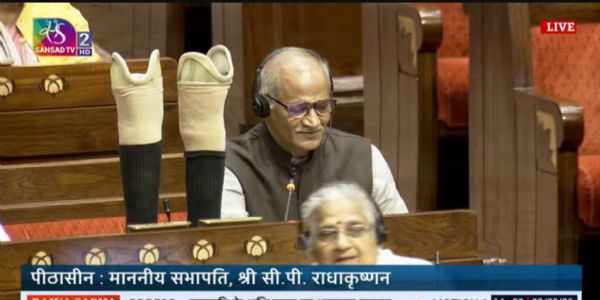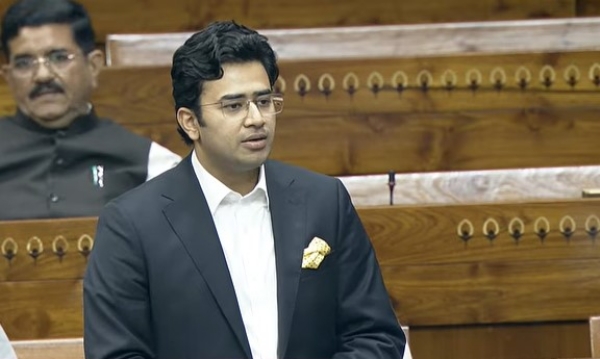
New Delhi, 02 February (H.S.): BJP MP from Bengaluru South, Tejasvi Surya, delivered a scathing critique of the UPA regime during Monday's Lok Sabha debate on the Motion of Thanks to President Droupadi Murmu's address, branding it a decade of lost opportunities marked by incessant excuses for multifaceted failures.
Seconding the motion moved by Union Minister Sarbananda Sonowal, Surya asserted that weak leadership fabricates pretexts amid adversities, whereas exemplary leadership—exemplified by the BJP—delivers tangible outcomes despite hurdles, encapsulating the quintessential divergence between Congress and BJP paradigms.
Governance Triumphs Under Modi
Marking the Narendra Modi government's 12th year, Surya hailed the President's address as a cornerstone of Amrit Kaal's second decade, spotlighting India's status as the fastest-growing major economy amid global downturns, the emancipation of 25 crore citizens from multidimensional poverty, and the infusion of aspirations into the youth demographic.
He underscored Prime Minister Modi's unparalleled trajectory—securing a resounding third-term mandate with absolute majority—contrasting it with transient tenures in democracies like the US, UK, Japan, and Italy, attributing this to unwavering governance efficacy and public service delivery.
Contrasting UPA's Shortcomings
Juxtaposing UPA-era President's addresses rife with corruption scandals burdening the impoverished—such as 2011 lamentations over schemes' incomplete penetration—against 2026's acclaim for institutionalized transparency via Direct Benefit Transfer (DBT) channeling ₹6.75 lakh crore to beneficiaries, Surya illuminated stark progress.
The UPA decade, he lambasted, grappled with rampant inflation, sluggish growth, and perennial scapegoating of global recessions; conversely, today's narrative celebrates controlled inflation and accelerated expansion. Terrorism infiltrations, Naxal violence across 126 districts, and blasts were normalized then, with mortality reductions touted as victories—now supplanted by Operation Sindoor's decisive strikes, confining Naxalism to eight districts.
Cultural Renaissance and Empowerment
Post-Article 370 abrogation, Jammu and Kashmir transitioned from violence's epicenter to development's vanguard, while women's reservation—long-promised yet unfulfilled by UPA—has been realized. UPA addresses omitted temples, languages, and heritage; Modi initiatives encompass Kashi Vishwanath Corridor, Mahakal expansions, Ram Mandir, and Char Dham projects.
Youth ambitions evolved from government jobs to startups, entrepreneurship, and Ease of Doing Business—absent in prior discourses—propelling Viksit Bharat's blueprint, with India poised for an economic revolution. Citing European Commission President Ursula von der Leyen's affirmation that a thriving India stabilizes the world, Surya preemptively congratulated the INDIA alliance on impending electoral defeats.
---------------
Hindusthan Samachar / Jun Sarkar