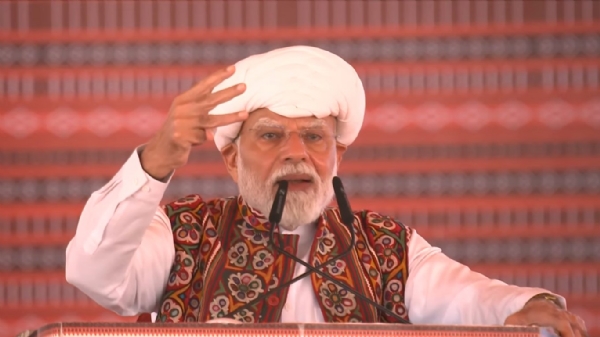
Banaskantha (Gujarat), 30 October (H.S.): Prime Minister Narendra Modi on Friday presented Gujarat’s Banaskantha district with a series of development projects worth more than Rs. 14,000 crore, laying foundation stones and inaugurating several initiatives aimed at strengthening agriculture, animal husbandry and rural infrastructure. He also released the 24th instalment of the Pradhan Mantri Kisan Samman Nidhi (PM-KISAN) scheme, transferring financial assistance amounting to approximately Rs. 19,000 crore to farmers across the country.
Addressing a public gathering in Banaskantha, the Prime Minister, without directly naming the Opposition, accused certain political groups of spreading rumours, indulging in politics during times of crisis and attempting to malign the government. He said some people appeared to derive satisfaction from the country's difficulties and resorted to spreading misinformation even when the nation was united in confronting challenges.
PM Modi said that while the country's youth and farmers were working towards the goal of building a developed India, certain elements were uncomfortable with this progress. He cited the global circumstances following the Iran conflict as a recent example, alleging that instead of supporting the country's collective efforts to navigate the situation, some people were engaged in spreading rumours.
The Prime Minister said misleading claims had been circulated about shortages of fertilisers for farmers and the possible disruption of cooking gas supplies to households. He alleged that the intention behind such claims was to create panic and discredit his government. Despite the ongoing conflict and global uncertainties, he maintained, the government had ensured that farmers did not face a shortage of fertilisers. Although fertiliser prices had risen sharply in international markets, the government had absorbed the additional burden rather than passing it on to farmers. PM Modi asserted that he would continue serving the people of the country until his last breath.
Referring to the increase in fertiliser prices over recent years due to global developments, PM Modi said the government had spent approximately Rs. 16 lakh crore to shield farmers from the impact of rising costs. He also said the government had fulfilled its commitment on Minimum Support Price (MSP). Under the Pradhan Mantri Fasal Bima Yojana, farmers had received compensation exceeding Rs. 2 lakh crore over the past 10-12 years, he added.
Highlighting the importance of the PM-KISAN scheme, the Prime Minister said it had become an integral source of support for millions of small farmers. So far, approximately Rs. 4.5 lakh crore had been transferred directly into farmers' bank accounts under the scheme. He pointed out that more than 85 per cent of India's farmers belonged to the small-farmer category, but their concerns had remained inadequately addressed for decades. His government, he said, had sought to bridge this gap by extending direct financial assistance to them.
PM Modi further stated that more than 50 lakh farmers in Gujarat had benefited from the scheme, while farmers in Banaskantha alone had received approximately Rs. 50 crore in assistance.
The Prime Minister noted that India's agricultural budget had increased more than fivefold compared with 2013-14. Over the past 12 years, wheat and paddy farmers had received Rs. 24 lakh crore through MSP procurement, he said. Describing agriculture as an integral part of India's traditions and cultural heritage, PM Modi emphasised that his government had worked to bring science and technology more extensively into agriculture and animal husbandry.
Citing the Soil Health Card initiative as an important example, he said farmers had earlier faced difficulties in determining the type and quantity of fertilisers required for their fields. The scheme had helped address this challenge by providing scientific information about soil quality and nutrient requirements. More than 26 crore Soil Health Cards had been issued to farmers across the country, he said.
He also highlighted efforts to help farmers adapt to changing climatic conditions, stating that nearly 3,000 new varieties of seeds had been made available to them over the past few years.
Emphasising the contribution of animal husbandry to the rural economy, PM Modi said women played a particularly significant role in the sector. Over the past decade, the government had focused on integrating science and technology into animal husbandry and dairy production, recognising that improved livestock breeds could substantially increase milk output.
Referring to the National Gokul Mission, he said the initiative was promoting the scientific breeding and conservation of indigenous cattle breeds. The research centre established in Banaskantha, he added, would further strengthen these efforts.
The Prime Minister also referred to the foundation stones laid for two Bio-CNG plants during the programme. He said the government's broader objective was to ensure healthier livestock, higher milk production and the optimum utilisation of cattle dung. Animal husbandry, he emphasised, should not remain confined to traditional practices but should become a stronger source of income for farmers and prosperity for rural communities.
Speaking about the benefits of solar energy for agriculture, Modi said that without the provision of solar pumps, farmers would have been compelled to purchase more than 80 crore litres of diesel. Solar-powered irrigation systems had helped them avoid this expenditure while also enabling additional electricity generation, he said.
The Prime Minister further claimed that five government schemes and policy decisions had collectively generated benefits worth Rs. 50 lakh crore for farmers across the country.
Highlighting Banaskantha's contribution to potato cultivation, PM Modi praised the district's farmers for establishing a strong reputation in the sector. He remarked that there was no need to promise local farmers that they could turn potatoes into gold, as they were already achieving remarkable results through their work.
Concluding his address, PM Modi said India's rapid economic growth amid global uncertainty had generated fresh hope across the world. He called upon citizens to move forward with the resolve of 'Ek Bharat, Shreshtha Bharat' (One India, Great India).
He also urged young people, in particular, to participate in the nationwide 'Run for Unity' programmes scheduled for October 31 to mark National Unity Day. Calling for a renewed commitment to national integration, he said people from Kashmir to Kanyakumari and Kutch to Kamakhya should come together to pay tribute to Sardar Vallabhbhai Patel and reaffirm their commitment to the unity and integrity of the country.
---------------
Hindusthan Samachar / Jun Sarkar
18 Aug 2026