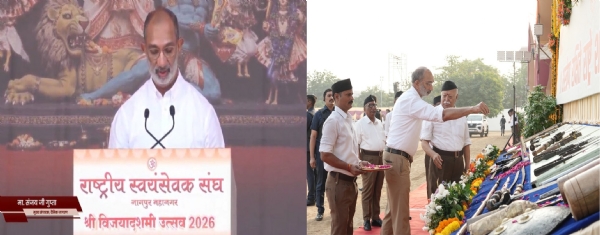
Nagpur, 20 October (H.S.) : India’s economic progress could make it a prosperous nation within the next 20 to 25 years, but the true greatness of the country will be determined not only by its economic strength but also by the character, morality, discipline, sense of national duty and cultural consciousness of its citizens. If India is to regain its golden age, character-building must be given priority. This is also the biggest challenge facing the Rashtriya Swayamsevak Sangh (RSS) in its next century. Sanjay Gupta, Editor in Chief of Dainik Jagran, made these remarks in his address on the occasion of Vijayadashami and the Sangh’s 101st foundation day. Describing the Sangh’s centenary journey as one of Bharatiyata, the unity of Hindu society, Sanatan cultural values and dedication to the nation, he said that taking India to Param Vaibhav requires positive change in the consciousness of society and the conduct of citizens, alongside economic development.
Addressing Dr Mohan Bhagwat and the assembled swayamsevaks, Gupta said the Sangh was founded at a time when the country was under British rule and social conditions were entirely different from today’s. At that time, the Sangh’s aim was to organise and strengthen Hindu society while also working for the country’s independence. The Sangh held that real freedom is incomplete without liberation from a slave mentality and without self-realisation. After Independence, the Sangh made individual-building, the spirit of Bharatiyata and commitment to the nation the main foundations of its work.
The Sangh’s ideological strength and the rise of the Jana Sangh and the BJP
Sanjay Gupta said that after Independence, those in political power, and a section of the political establishment, did not accept the Sangh’s ideology. The reason, he said, was the gap between the Sangh’s ideological direction and their politics of appeasement. Despite many challenges, the Sangh kept moving forward with its ideology and organisational work. Nationalist politicians and thinkers inspired by the Sangh’s work and ideas founded the Bharatiya Jana Sangh, which later developed into the Bharatiya Janata Party. Today, the BJP is the largest political party in the world.
He said the Sangh’s ideological inspiration and organisational strength have played an important role in the commitment to Bharatiyata, nationalism and Indian values that is visible in the BJP’s top leadership and many other leaders. The Sangh and its affiliated organisations are accused of promoting Hindu extremism, whereas in his view the Sangh has played an important role in preserving Hindu values and the Hindu way of life.
Gupta said that if the identity of Bharatiyata and Hindutva still commands influence across the world after nearly six centuries of subjugation, including Mughal and British rule, the Sangh’s contribution should also be given credit. Having completed its centenary year, the Sangh is now moving ahead with the goal of bringing about social change and strengthening Indian cultural values over the next hundred years.
The challenge of social change amid vote-bank politics
The Editor-in-Chief of Dainik Jagran said that organisations working in a spirit of selfless service will always be needed to remove the evils that take root in society over time. Social reform is also the responsibility of political parties, but political ambitions driven by vote banks sometimes create new social problems. With some exceptions, a section of the public appears to have weakening trust in political leadership, especially when it comes to its own development and social interests. In such circumstances, the relevance of the Sangh and its affiliated organisations grows.
Referring to the social challenges facing the country, he said India is advancing rapidly in economic terms. There is a prospect of the country becoming a prosperous nation in the next two to two and a half decades, but the real question is whether this prosperity will also enrich the consciousness and subconscious of society. Today, society appears divided along lines of caste, class, sect and religion. A lack of tolerance, weak commitment to moral values, inadequate understanding of duties and an absence of discipline are serious challenges in social life.
Gupta said citizens must change their thinking. There is generally an expectation of what the system is giving them, whereas citizens should also ask what the country has given them and what they can contribute in return. Duty to the nation, respect for the law, social responsibility and discipline are the foundations of any developed society. Without these values, the wider social benefits of economic progress may remain incomplete.
Shared cultural concerns of Dainik Jagran and the Sangh
Referring to Dainik Jagran’s editorial policy, Sanjay Gupta said the newspaper’s ideological commitment is tied to faith, devotion to the nation and the values of Sanatan Indian civilisation. Its core spirit, he said, is to encourage social harmony and goodwill with a positive outlook, and to inspire citizens to contribute to the nation. He said there is a similarity between the concerns of the Sangh and those of Jagran in terms of dedication to Indian culture and the nation.
He clarified that, as a large and responsible media group, Dainik Jagran considers it its moral responsibility to make citizens aware of their duties. With this aim, the group is working continuously on seven key concerns (sarokar): an educated society, environmental protection, water conservation, a healthy society, women’s empowerment, poverty alleviation and population planning. These concerns advance the broader idea of national upliftment alongside social development.
Cultural identity is as essential as economic strength
Gupta said a nation’s identity is not determined by its economic achievements alone. The values, cultural consciousness and way of life of its citizens also shape its identity. Economic strength has contributed to India’s rising stature on the international stage since Independence, but the importance of India’s cultural heritage has endured for thousands of years and remains intact today.
Referring to the various sects and ways of life that developed within the Indian cultural tradition, he said that many sects also arose because of anomalies that emerged over time within the Hindu way of life. In his view, in the absence of the Sangh and its affiliated organisations in independent India, there could be a danger of Hindu society becoming even more divided along caste lines. He expressed concern that the tendency to define the present Hindu way of life on the basis of separate caste identities could weaken social unity.
He said that in the last century the Sangh focused on the challenges facing Hindu society and the problems linked to the politics of appeasement. In the coming century, giving priority to building the character of society is its main challenge.
Character-building is the path to India’s golden age
Sanjay Gupta said a person of good character understands his duties towards his nation. Dedication to the nation, responsibility and a sense of duty are essential qualities of such a citizen. If India is to regain its golden age, these qualities must be developed in society. Advancing economic progress, cultural self-confidence and moral conduct together can form the basis of the country’s long-term strength.
Describing Vijayadashami as a symbol of the victory of justice over injustice and truth over falsehood, Gupta thanked the Sangh leadership for the invitation. On behalf of the Jagran group, he prayed that the Rashtriya Swayamsevak Sangh, which is constantly striving to take India to the pinnacle of Param Vaibhav, become even stronger. He concluded his address with the cry of “Bharat Mata ki Jai”.
---------------
Hindusthan Samachar / Mayank Chaturvedi
18 Aug 2026