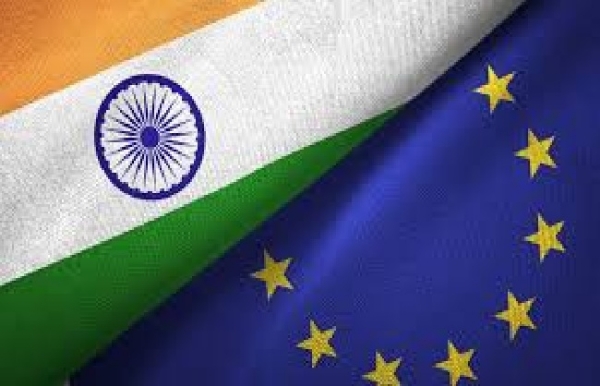
New Delhi, 26 January (H.S.): Duty reductions on labor-intensive sectors such as textiles and footwear, alongside automobiles and wine, appear feasible under the prospective free trade agreement (FTA) between India and the 27-nation European Union (EU). Official sources revealed on Monday that the pact is likely to incorporate liberalized regulations across numerous service sectors as well.
European Commission President Ursula von der Leyen arrived in India on January 24 for a four-day visit to advance this agreement. Accompanied by European Council President António Costa, she is scheduled to hold a summit with Prime Minister Narendra Modi on January 27, where signing the deal and issuing a joint statement could be announced.
Sources indicate that India has prioritized zero-duty access for its labor-intensive industries, including textiles, leather, apparel, gems and jewelry, and handicrafts—demands successfully accommodated in prior FTAs with the UK, UAE, and Australia.
Conversely, the EU seeks tariff concessions on its automobiles and alcoholic beverages like wine. Notably, India's UK FTA features quota-based automotive relief, while deals with Australia and New Zealand encompass wine; specifically, Australian wine receives phased duty reductions over a 10-year period. India and the EU are poised to declare the FTA's culmination on January 27, capping 18 years of negotiations initiated in 2007.
The EU imposes an average tariff of 3.8% on Indian goods, escalating to nearly 10% on labor-intensive items; in reciprocity, India's average stands at 9.3%, encompassing steep levies on automobiles (35.5%) and chemicals.It merits mention that the European Union comprises 27 nations from Europe's 50 countries, functioning akin to a sovereign entity with its own currency, flag, central bank, parliament, and judiciary.
All citizens of member states hold EU citizenship. The roster includes Austria, Belgium, Bulgaria, Croatia, Cyprus, Czech Republic, Denmark, Estonia, Finland, France, Germany, Greece, Hungary, Ireland, Italy, Latvia, Lithuania, Luxembourg, Malta, Netherlands, Poland, Portugal, Romania, Slovakia, Slovenia, Spain, and Sweden.
Hindusthan Samachar / Jun Sarkar