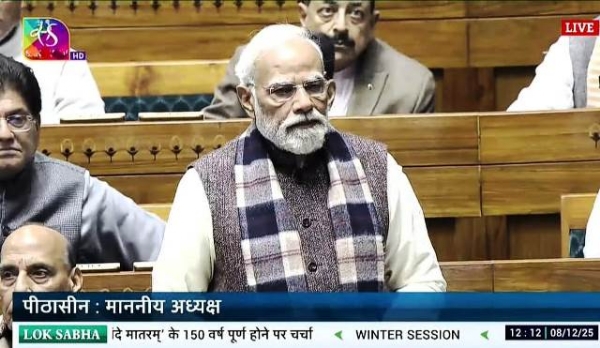
New Delhi, 8 December (H.S.): Prime Minister Narendra Modi on Monday urged the nation to draw inspiration from Vande Mataram as India moves from independence toward prosperity, describing the 150-year-old song as a “flowing river of inspiration” that continues to guide the country’s spirit.
Inaugurating a special discussion in the Lok Sabha to mark 150 years of Vande Mataram, the Prime Minister compared the song’s legacy to a sacred current that once fueled freedom and now must drive progress and self-reliance. “Vande Mataram carries with it a stream of energy and inspiration. After independence, it must now lead us toward prosperity,” he said.
PM Modi remarked that Vande Mataram was unjustly treated in the last century, recalling Mahatma Gandhi’s belief that the song had become so beloved it “deserved to be the national anthem.”
The Prime Minister stressed the need to revisit the historical circumstances that pushed this revered sentiment into controversy.Presenting a detailed historical perspective, Modi accused the Congress Party of “injustice” to the song, alleging that Pandit Nehru and the Congress leadership yielded to political appeasement following opposition from the Muslim League. He cited a 1937 letter written by Nehru to Subhas Chandra Bose, in which Nehru allegedly described Vande Mataram as “irritating” to Muslims following Muhammad Ali Jinnah’s objections.
“It was the truncation of Vande Mataram that sowed the seeds of partition,” Modi asserted, claiming that Congress’ compromises undermined national unity under the guise of communal harmony.
The Prime Minister began his speech by paying homage to known and unknown freedom fighters inspired by Vande Mataram, emphasizing how the song shaped India’s nationalist awakening. Reflecting on the country’s state during key milestones, Modi said, “When the song turned 50, India was enslaved; at 100 years, we were under the Emergency, when the Constitution itself was throttled. At 150, we must once again reclaim our pride and reaffirm our unity.”
Recalling the song’s revolutionary impact during colonial rule, Modi said Vande Mataram challenged British propaganda and awakened self-esteem among Indians. “Bankim Chandra Chattopadhyay wrote these lines to shake India out of inferiority and reveal her divine strength — ‘You are Durga, bearer of ten weapons… You are the fertile, beautiful motherland… Vande Mataram!’”
He added that the song evolved as a cultural force defining India’s civilizational vision, showing that the freedom struggle was “not merely for power or territory, but for the restoration of a great culture’s dignity.”
Modi also recounted how the British feared the song’s unifying power, responding with their ‘divide and rule’ policy and implementing the partition of Bengal. Despite prohibitions on singing or publishing it, Vande Mataram echoed through the streets of Bengal as a cry of defiance. “The intellectual might of Bengal once guided the entire nation,” he said.
“The British understood that Bengal’s strength was India’s core strength. That is why they sought to divide it.” He recalled that Barisal — now part of Bangladesh — witnessed large-scale protests led by women against the ban on singing Vande Mataram.
The Prime Minister concluded by calling on lawmakers and citizens alike to participate in this “moment of gratitude,” saying, “This discussion is not between ruling and opposition benches; it is a moment to honor the spiritual debt we owe to those who awakened this nation through Vande Mataram.”
---------------
Hindusthan Samachar / Jun Sarkar
08 Dec 2025
Supreme Court Issues Notice on Plea Challenging Karnataka CM Siddaramaiah’s 2023 Election Victory
08 Dec 2025