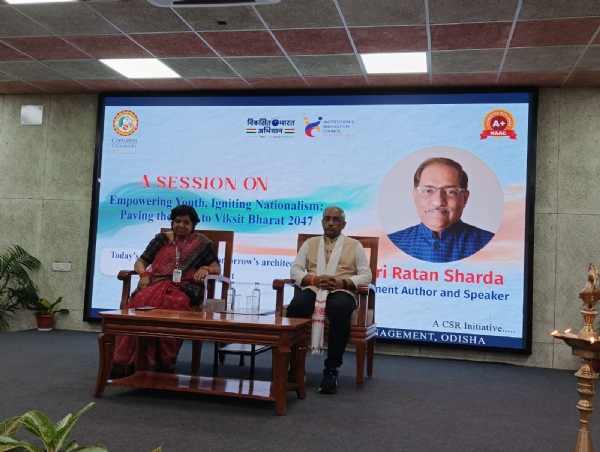
Bhubaneswar, 07 September (H.S.): India is witnessing a significant transformation in the aspirations and outlook of its younger generation, with youth increasingly seeking to excel on the global stage rather than merely participate, eminent author and speaker Ratan Sharda said at a special session on youth empowerment and nationalism at Centurion University, Bhubaneswar.
The session, titled “Empowering Youth, Igniting Nationalism: Paving the Path to Viksit Bharat 2047,” was organised in collaboration with the Democracy Research Foundation. Centurion University Vice-Chancellor Prof. Supriya Patnaik was also present on the occasion.
Sharda said the growing achievements of Indian youth in science, technology, space and sports reflected a renewed sense of confidence in the country's ability to compete with and lead the world. Citing India's achievements in squash, hockey, archery, cricket, relay racing and other sports, he said the aspiration of today's generation had shifted from simply participating to winning and becoming global leaders.
Sharda said earlier generations often considered participation itself an achievement. In cricket, for instance, defeats were sometimes softened by the sentiment that the team had “won the hearts of the people”.
However, he said, today's youth are increasingly unwilling to settle for participation. They aspire to win championships, achieve excellence and establish India as a leading global power.
According to Sharda, this change reflects a broader transformation in national consciousness and growing confidence among India's young population.
Sharda stressed that national confidence must be supported by greater awareness of India's history and civilisational heritage.
He called for greater recognition of the contributions of the Kalinga, Chola and Ahom kingdoms, as well as tribal freedom fighters who resisted British rule. He also highlighted India's scientific and intellectual traditions, referring to scholars such as Bhaskaracharya, Sushruta and Charaka.
He said the achievements of Indian scholars in mathematics, medicine, astronomy and science should be presented more comprehensively to younger generations, arguing that knowledge of the country's heritage can strengthen confidence and national pride.
Highlighting Odisha's maritime history, Sharda referred to Balijatra as a symbol of Kalinga's ancient trade and cultural links with Bali and other parts of Southeast Asia.
He said favourable seasonal winds enabled Kalinga's traders and sailors to undertake maritime journeys and establish commercial and cultural connections across the region.
He also referred to ancient trade routes such as Uttarapatha and Dakshinapatha, along with India's pilgrimage traditions, to underline the cultural links that existed across different regions despite political boundaries.
Sharda said national pride should be accompanied by a strong sense of responsibility towards society. He argued that nationalism should not remain limited to emotional attachment to the country but should be reflected through responsible citizenship, ethical conduct, social participation and a willingness to contribute to nation-building.
He also highlighted the broader meaning of Dharma, linking it with duty, responsibility, fairness and ethical conduct.
The speaker also urged young people to recognise their responsibility towards the environment. He said the Earth's resources are finite and that excessive consumption must be reduced.
Reducing plastic use, avoiding water wastage and purchasing only what is necessary are simple measures that, when adopted collectively, can create a significant impact, he said.
Sharda cited the Kumbh Mela in Prayagraj as an example of how community participation and the use of reusable items can help reduce waste and conserve resources.
Sharda said rapid technological change, particularly the rise of artificial intelligence, is transforming the employment landscape.
He emphasised that conventional academic qualifications alone may no longer be sufficient for long-term career success. Young people must continuously learn new skills, adapt to emerging technologies and remain prepared to reskill throughout their careers.
He urged the youth to view uncertainty as an opportunity rather than a source of fear or frustration, stressing the importance of flexibility, resilience and lifelong learning.
Sharda said India's transformation cannot depend solely on government policies and institutions. Young citizens must actively contribute to the country's development while recognising their responsibilities towards society and the nation.
He said the goal of Viksit Bharat 2047 requires not only economic and technological strength but also responsible citizenship, national confidence, social participation, environmental consciousness and continuous skill development.
“The youth must combine India's rich cultural values with modern education, technology, innovation and skills,” he said, emphasising that a confident and capable younger generation will be central to shaping India's journey towards a developed and globally respected nation by 2047.
---------------
Hindusthan Samachar / Monalisa Panda

18 Aug 2026
ED raids KPSC office, 20 other locations over Karnatak veterinary recruitment scam
ED raids KPSC office, 20 other locations over Karnatak veterinary recruitment scam..