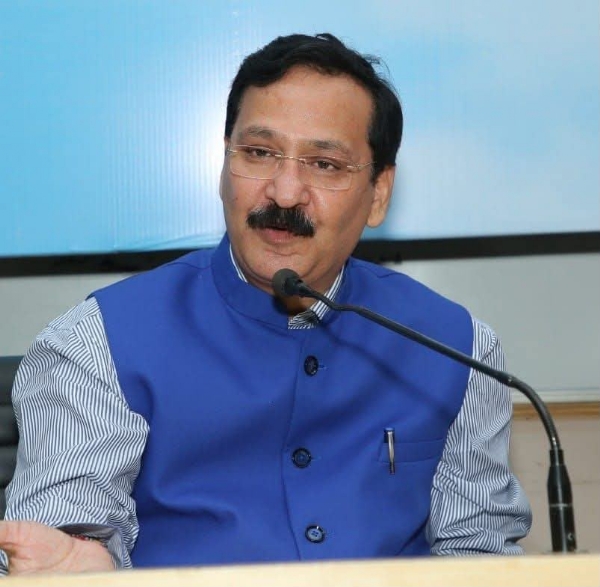
New Delhi, 07 September (H.S.): Former Director General of the Indian Institute of Mass Communication (IIMC), Prof. Sanjay Dwivedi, has urged young people to use digital platforms judiciously, saying that it is essential to become a citizen before becoming a netizen. Digital media is a useful tool, but it should not be allowed to become a substitute for life. Young people should use technology for knowledge creation, education, communication, employment and expanding new opportunities.
Prof. Sanjay Dwivedi made the remarks while addressing online the inaugural lecture series organised by ‘Sahityayan’, an institution established for the promotion of literature, art and culture, on Monday. Speaking on the topic ‘Digital Media and the Youth Perspective on Life’, he said the present era is defined by vernacular, voice and video. The digital revolution has created unprecedented opportunities for Indian languages. Digital platforms have removed many barriers related to language and script and have provided literature, cinema, theatre, art and cultural knowledge in Indian languages with a global platform.
He said that not every piece of information that goes viral on digital platforms is necessarily true. Before sharing any message, news report or video, it is essential to verify its source, context and credibility. Young people should become responsible digital citizens rather than merely digital consumers. Emphasising the need for media literacy, he said, “Do not type anything bad, do not like anything bad and do not share anything bad.” He said that disseminating content without verification can be harmful to both individuals and society.
Prof. Dwivedi said that freedom of expression on social media also comes with responsibility. While expressing disagreement is a citizen’s right, insults, hatred, harassment and the dissemination of misleading information do not constitute appropriate digital behaviour.
Referring to the possibilities and challenges posed by Artificial Intelligence (AI), he said that AI has opened up new opportunities in education, translation, language refinement, content creation, voice recognition, advertising and communication. At the same time, it has created new challenges for human originality, critical thinking and creative labour. Excessive dependence on machines can weaken human beings’ capacity for independent thought. Young people should become masters of technology, not its slaves, he said.
He also expressed concern over the dangers posed by deepfakes and artificially generated content. He said that in the age of AI, the need to verify information has become more important than ever. A person’s voice, photograph or video can be artificially manipulated to mislead society. Therefore, media and information literacy should be made part of the curriculum from school education through higher education.
He said that regardless of the availability of advanced technology, language and tools, a creative work cannot become truly impactful unless it reflects human suffering, struggles and emotions. Describing multilingualism as India’s cultural strength, he said that it is not a weakness of the country but a matter of pride.
At the beginning of the programme, Prof. Harish Arora of PGDAV College (Evening), University of Delhi, and patron of ‘Sahityayan’, said that the organisation’s objective is not limited merely to literature and language. He said that along with online programmes, the organisation would also organise in-person events in the future.
---------------
Hindusthan Samachar / Jun Sarkar
18 Aug 2026
ED raids KPSC office, 20 other locations over Karnatak veterinary recruitment scam
ED raids KPSC office, 20 other locations over Karnatak veterinary recruitment scam..