Bijapur, September 05 (H.S.): A rock discovered beneath the forest floor in the Bhopalpatnam area of southwestern Bijapur district in Chhattisgarh has been dated by scientists to approximately 3.65 billion years, making it the oldest rock remnant identified so far on the Indian landmass.
The rock dates back to a period when the Earth was in the early stages of forming its crust. The discovery has pushed back the recorded geological history of India by nearly 150 million years. For a long time, Singhbhum in Jharkhand was regarded as India’s oldest known rock-bearing region. Earlier studies in the Bastar region had identified rocks dating back approximately 3.56 billion years.
The latest discovery has pushed that record back by around 150 million years. According to researchers, the 3.64-3.60-billion-year-old rocks of Bastar could be among the oldest known magmatic charnockites in the world. The finding is considered significant for understanding the geological evolution of the early Earth.
The discovery was made in the vicinity of the Bijapur-Bhopalpatnam corridor, which forms part of the Bastar Craton. A craton is an ancient, relatively stable portion of the continental crust that survives over hundreds of millions of years despite geological processes such as collisions, pressure, burial and melting.
The study, titled “Petrochronological Constraints on Eoarchean Subduction: Evidence from the Southwest Bastar Craton, India,” involved Professor Pritam Nasipuri and Kaushik Satpathy of IISER Bhopal, Professor Ki-Wook Yi of the Korea Basic Science Institute, and former IIT Kharagpur professor Abhijit Bhattacharya.
According to the researchers, a major geological event occurred in the region around 3.65 billion years ago. This was followed by another phase between 3.64 billion and 3.60 billion years ago, while evidence of the rocks being reactivated or reworked was found dating to between 3.44 billion and 3.40 billion years ago.
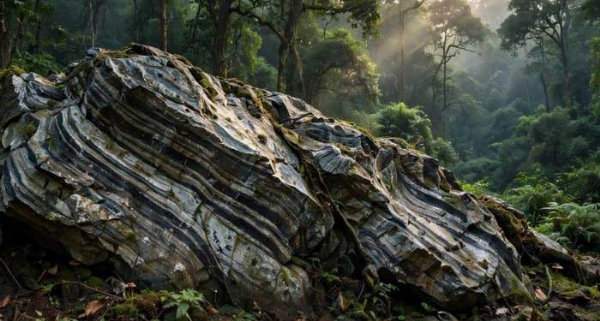
The study identified two distinct types of rocks. The oldest among them is gneiss, a banded rock whose structure, according to scientists, preserves evidence of the complex transformations that occurred during the early history of the Earth.
Professor Pritam Nasipuri said the rock formed deep beneath the Earth’s surface, where it underwent processes including heating, partial melting and subsequent recrystallisation or reworking. These processes are believed to have occurred approximately 30-50 kilometres below the surface and possibly at temperatures exceeding 1,000 degrees Celsius.
Chemical and isotopic evidence suggests that subduction-related processes may have been active on Earth more than 3.6 billion years ago. Researchers believe these processes could represent early precursors to modern plate tectonics.
---------------
Hindusthan Samachar / Jun Sarkar

18 Aug 2026