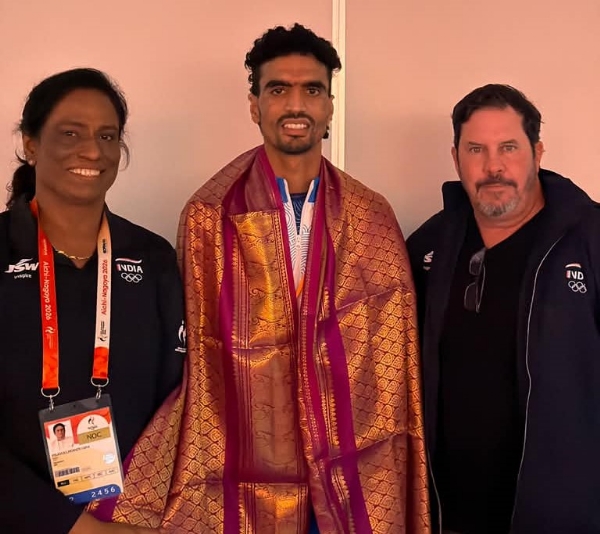
New Delhi, 30 September (H.S.): American coach Scott Simmons has played a significant role in the historic performance of India’s distance runners at the Asian Games 2026. Training under his guidance at a high-altitude facility in Colorado Springs, United States, Gulveer Singh, Seema Kumari and Sawan Barwal won medals in Aichi-Nagoya, raising fresh hopes for India’s distance-running programme.
Simmons, who once described Indian distance running as a “sleeping giant”, is now looking towards the 2028 Los Angeles Olympics following the athletes’ impressive showing at the Asian Games.
Gulveer Singh competed in four races within five days in Nagoya and won three medals. He secured silver in the men’s 10,000m and 1,500m events and bronze in the 5,000m. Earlier, at the 2026 Commonwealth Games in Glasgow, Gulveer had won silver in the 10,000m and bronze in the 5,000m. His preparation under Simmons in Colorado Springs was primarily focused on the 10,000m.
Speaking to SAI Media, Simmons said, “The plan worked very well. We were definitely 100 per cent prepared for the 10,000m. Gulveer ran his best and won the silver medal. We felt that was his best event, but that preparation also prepared him for the 1,500m.”
Gulveer’s three Asian Games medals represent a significant improvement on the bronze he won in the 10,000m at the 2022 Hangzhou Asian Games. According to Simmons, consistency has been the biggest factor behind the progress.
Recalling his first observations of Indian distance runners after arriving in Bengaluru in early 2022, Simmons said he found the discipline to be a “sleeping giant”. However, he stressed that athletes needed time, support and consistent training to reach their potential.
“We just needed time and support from the Government of India, the Target Olympic Podium Scheme (TOPS), the Athletics Federation of India (AFI) and other stakeholders to give these athletes the right training opportunities, the time to develop and the consistency,” Simmons said.
With support under the Sports Ministry’s ACTC programme, the AFI took an important step before Nagoya by sending athletes such as Gulveer to the United States for continuous six-month training periods. This gave Gulveer the opportunity to train consistently in Colorado Springs and compete alongside athletes competing at an international level.
Simmons said the key difference had been consistency.
“I don’t think there was consistency before. There was always a last-minute rush to get fit for the Asian Championships and the Asian Games. In distance running, especially, it is like building a house. You are always building the house. When you are not building it, you are tearing it down. Gulveer has done a fantastic job of building consistency, taking one step, then another, and another,” he said.
Sawan Barwal Also Makes History
Sawan Barwal also benefited from the same training environment. Barwal won silver in the men’s marathon in a time of 2 hours, 11 minutes and 37 seconds. His performance improved his own national record and ended India’s 44-year medal drought in the Asian Games marathon.
Simmons said Barwal’s preparation had been highly structured despite his limited experience in the marathon. He described training alongside experienced marathon runners in Colorado Springs as an important part of Barwal’s development.
“He has had the opportunity to train with athletes at that level,” Simmons said.
Referring to Barwal’s young age and limited experience over the marathon distance, Simmons said, “He has some challenges because he is still young and new to the distance, but it was very good preparation. Next time it will be even better. He can continue to improve through marathon-specific preparation, and hopefully that progression will ultimately help him qualify for the Beijing World Championships.”
Seema Kumari Also Wins Bronze
The success of the Indian athletes was not limited to Gulveer and Barwal. Simmons also highlighted the performances of other Indian athletes in his training group, including Seema Kumari, who won bronze in the women’s 10,000m in Nagoya.
It was India’s first Asian Games medal in the event since 2010.
Simmons said the athletes’ success had been built around an environment in which runners train together, learn from one another and challenge themselves to reach the next level collectively.
“When we all train together, everyone gets better and everyone can reach the next level. That is what we saw from the Indian athletes’ performances in Nagoya,” he said.
Eyes on the Los Angeles Olympics
Simmons is now turning his attention to the Los Angeles 2028 Olympics. He believes the Indian athletes training in Colorado Springs have developed the confidence to target Olympic qualification, although the qualification standards are becoming increasingly demanding.
“They believe they can qualify, and qualifying is more difficult than ever. But again, they are part of a training group where other athletes are also pursuing the same goal,” Simmons said.
The American coach also emphasised the need to bring two to four more young athletes into India’s long-distance programme. In his assessment, developing athletes to this level can take between two and four years.
Following the historic performance by India’s distance runners in Nagoya, Simmons’ message is clear: sustained training, exposure to international-level athletes and long-term planning can help Indian distance runners strengthen their credentials on the biggest global stages.
---------------
Hindusthan Samachar / Jun Sarkar
18 Aug 2026
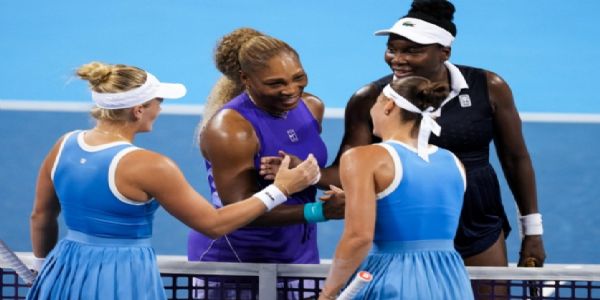
Cincinnati Open: Williams Sisters Fall in First Round, Kostyuk-Stearns Duo Edges Them Out in Super Tiebreak

18 Aug 2026