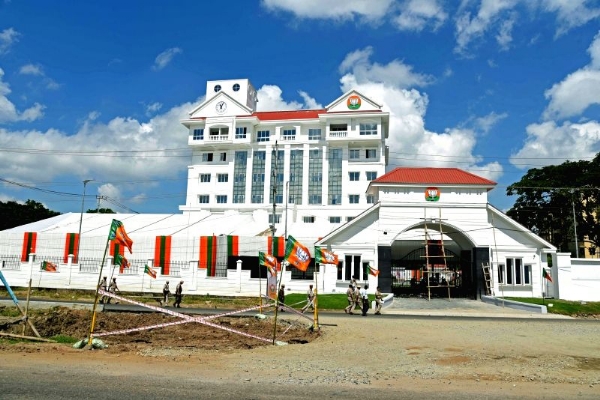
Guwahati, 30 September (HS): A discussion on “Nationalist Politics and Cultural Nationalism” was organised at the BJP state office in Guwahati on Wednesday, with prominent RSS worker from Assam, Tirthankar Das Kalita, as the speaker.
The session was inaugurated by BJP Chief Spokesperson Kishore Upadhyay, who welcomed the participants and introduced Kalita.
Addressing the gathering, Kalita elaborated on the concepts of nationalism and cultural nationalism and their place in India’s civilisational perspective. He explained the terms Rashtra, Dharma and Sanskriti, noting that their meanings cannot always be fully captured by the English terms “nation”, “religion” and “culture”.
Kalita spoke about India’s historical traditions and said that, within the civilisational understanding of Bharat, rulers and kings were traditionally considered subject to the law. He also emphasised collective welfare and the civilisational concept of nationalism.
He discussed the distinction between tribalism, territorialism and nationalism and spoke about the impact of British colonial policies on tribal communities. He alleged that colonial policies exploited, excluded and categorised tribal communities and claimed that similar approaches continued in different forms after Independence under Congress governments.
Kalita also explained the BJP’s concept of Antyodaya in the context of decentralisation and ensuring that development reaches the last person in society. He said modern Western nationalism is a relatively recent political concept, while India, according to him, has historically maintained a collective civilisational identity across its geographically diverse regions.
Referring to former Union Minister Sushma Swaraj’s explanation of cultural nationalism, Kalita cited the example of a Bengali family settled in Assam naming their child “Somnath”, a name associated with Gujarat, to illustrate cultural connections that transcend territorial boundaries.
He also highlighted the significance of the Sanskrit expression “Vasudhaiva Kutumbakam” and its relevance in contemporary society. Referring to “Satyameva Jayate”, the national motto of India, he noted its Upanishadic origin and discussed the relationship between India’s civilisational traditions, Hindutva and the constitutional framework.
The programme concluded with an interactive question-and-answer session, during which Kalita responded to questions from participants.
Upadhyay delivered the vote of thanks and expressed appreciation to Kalita for sharing his perspectives and to all participants for attending the discussion.-----------
Hindusthan Samachar / Sriprakash
18 Aug 2026
ED raids KPSC office, 20 other locations over Karnatak veterinary recruitment scam
ED raids KPSC office, 20 other locations over Karnatak veterinary recruitment scam..