New Delhi, 03 September (H.S.):
India and Belgium have signed 10 major strategic agreements aimed at taking bilateral cooperation in the defence industry to a new level. Under the agreements, advanced defence equipment, including ammunition, 70-mm rockets, naval mine-countermeasure systems, counter-drone systems and marine diesel engines, will be manufactured and co-produced in India.
The cooperation is expected to strengthen India’s “Make in India” initiative and defence manufacturing capabilities while laying the foundation for a long-term partnership between the defence industries of the two countries.
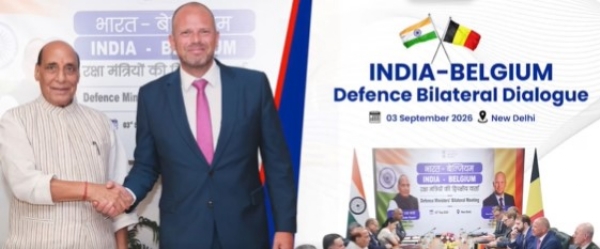
According to the Ministry of Defence, during Belgian Prime Minister Bart De Wever’s official visit to India from September 2 to 4, a high-level delegation-level meeting was held in New Delhi on Thursday between Defence Minister Rajnath Singh and Belgian Defence and Foreign Trade Minister Theo Francken. During the meeting, the two sides signed a Letter of Intent for long-term structural cooperation between their armed forces. A cooperation agreement was also signed between the Belgian Security and Defence Industry and the Society of Indian Defence Manufacturers.
A delegation representing 15 major Belgian defence companies has also accompanied Prime Minister Bart De Wever to India. These companies have entered into agreements with Indian defence firms for the domestic production of advanced military equipment, rockets, naval systems and counter-drone technologies.
During the talks, the two sides discussed several issues, including the growing interconnection between security in Europe and the Indo-Pacific, maritime security and exchanges between military officers. The Belgian Defence College has also planned to conduct its “World Study Trip” in India in 2027.
Among the key agreements between the defence industries of the two countries is a pact between Liège-based defence and engineering company New Lachausse and Tempo Classic Engineering. The deal, worth around 50 million euros, or approximately Rs 450 crore, involves the supply of complete production lines for two different ammunition calibres, along with tooling for two additional calibres. The proposed facility is expected to have a production capacity of around 100 million rounds annually. Supplies are scheduled for 2028 and 2029.
Another significant agreement has been signed between Exail Belgium and Larsen & Toubro. Under the agreement, Exail’s autonomous toolbox will be provided for mine-countermeasure vessels of the Indian Navy. The system will assist in detecting, identifying and neutralising naval mines. In the first phase, the project will cover 12 vessels and could subsequently be expanded to 59 ships. It is being regarded as one of the largest projects under the existing defence industrial cooperation between the two countries.
Under an agreement between Thales Belgium and Kalyani Strategic Systems, Belgium’s 70-mm rockets will be assembled and manufactured in India. Indian suppliers will also be incorporated into the project. According to the plan, the first fully India-manufactured rocket could be ready at the beginning of 2027.
FN Herstal and Kalyani Strategic Systems are also working towards establishing a joint production facility in India. The proposed facility will manufacture FN weapons, integrated weapon systems and counter-drone systems. The initiative is expected to promote the local production of advanced weapon systems within the Indian defence industry.
Brussels-based counter-terrorism and security company Pitagone and Krishna Allied are establishing a joint venture named “Pitagone India”. Pitagone will hold a 51 per cent stake in the venture. The company will manufacture mobile barriers designed to protect against vehicle-borne attacks. India is planned to be developed as the production base for the joint venture, with security products manufactured here to be exported to markets in Southeast Asia.
Flemish drone manufacturer SolvEn is working with DGVK Enterprises to introduce its “Saboteur” drone, along with “Buzzkill” and “Hitchhiker” interceptor drones, in the Indian market. The Indian Armed Forces have expressed interest in testing these systems. Cooperation in drones and counter-drone technologies is an important component of the defence industrial partnership between India and Belgium.
OIP Sensor Systems and India Optel Limited have agreed to expand cooperation in electro-optical systems for the Indian Army’s Arjun main battle tank. OIP has already supplied more than 130 sights for the Arjun Mk-1 tank. The company has also developed a new fire-control system for the Arjun Mk-2, which is capable of firing laser-guided missiles.
The cooperation between John Cockerill Defense and Larsen & Toubro is linked to India’s indigenous light tank, the Zorawar. The Belgian company has emerged as a leading contender to supply the turret for the light tank being developed for deployment along the China border near the Line of Actual Control. This could pave the way for the use of Belgian defence technology in India’s light tank programme.
The cooperation between Octave and Bharat Electronics Limited is focused on strengthening India’s air defence architecture. Octave’s technology is playing a role in Indian air defence programmes such as Akash Teer, Arudhra, IPSS and IACCS. The two companies are working to expand this cooperation further and strengthen India’s air defence capabilities.
Anglo Belgian Corporation and Kirloskar are also in discussions to manufacture a 6-megawatt marine diesel engine in India. This would be the first marine diesel engine of this capacity to be developed in India. Such engines could play an important role in powering larger naval warships in the future.
---------------
Hindusthan Samachar / Jun Sarkar

18 Aug 2026