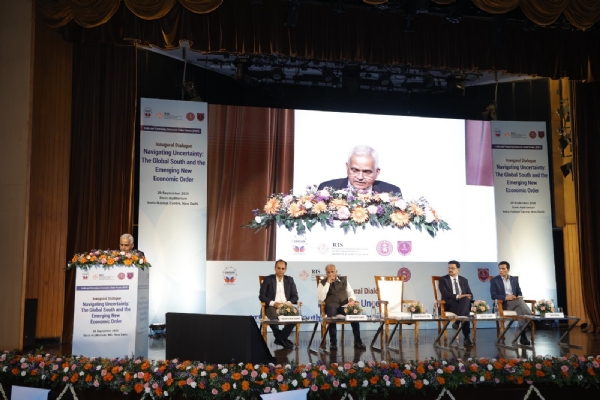
New Delhi, 29 September (H.S.): The Research and Information System for Developing Countries (RIS) and the Delhi School of Economics (DSE), University of Delhi, have jointly launched the India and Emerging Economic Order Forum (IEOF), a platform aimed at fostering sustained intellectual and policy dialogue on the far-reaching transformations taking place in the global economy and their implications for India and the Global South.
Shaktikanta Das, Principal Secretary-2 to the Prime Minister and former Governor of the Reserve Bank of India, formally launched the forum. He delivered the inaugural address on “Global South: India’s Role in Shaping the New Geo-economic Order”. The event was chaired by Professor Yogesh Singh, Vice-Chancellor of the University of Delhi.
Das said the global economy was currently undergoing profound geopolitical and geo-economic transformations. The eastward shift in the centre of gravity of global economic activity and the growing economic and geopolitical significance of the Global South were among the defining features of this transition.
He said these developments were creating new opportunities for developing countries, while also requiring fresh ideas and strategies to capitalise on them. The IEOF, he said, could emerge as an important platform for high-quality research and substantive dialogue in this direction.
Das said the combined economic output of emerging-market and developing economies had stood at around US$7.3 trillion in 2000 and had risen to more than US$48.8 trillion by 2025. The Global South currently represents around 85 per cent of the world’s population and approximately 40 per cent of global economic output. Its share of global manufacturing output stands at 45 per cent, while it accounts for 46 per cent of merchandise exports and 57 per cent of foreign direct investment inflows.
Despite this progress, Das said, the development journey of the Global South remained incomplete. Poverty, debt vulnerabilities, infrastructure deficits, climate change, food and energy insecurity, unequal access to technology and protectionist policies continued to pose significant challenges.
He identified food security, trade diversification, participation in global supply chains, the energy transition, macroeconomic stability and employment generation as key priorities.
In the Indian context, he emphasised macroeconomic and financial stability, structural reforms, infrastructure development, industrial growth and deeper global integration. He also highlighted India’s initiatives in areas including digital public infrastructure, space, nuclear energy and offshore exploration.
Das also underlined India’s development partnerships with countries of the Global South, along with capacity building, concessional financing and mutually beneficial cooperation. Greater collaboration among developing countries, he said, could strengthen their collective voice on issues such as trade, climate finance, technology transfer, supply chains and reform of global financial institutions.
The IEOF’s future agenda will focus on areas including supply chains and innovation, policy and programme evaluation, climate finance and economic resilience, urbanisation and infrastructure finance, local-currency financing and financial inclusion.
Das called for greater mutual learning from successful initiatives, citing India’s Aadhaar, Unified Payments Interface (UPI) and DigiLocker, Kenya’s M-Pesa and Brazil’s social security programmes as examples of experiences that could offer valuable lessons across countries.
Earlier, Professor Sachin Kumar Sharma, Director General of RIS, delivered the welcome address. Professor Ram Singh, Director of the Delhi School of Economics, Dr Seshadri Chari, Member of the Governing Council, and Professor Yogesh Singh, Vice-Chancellor of the University of Delhi, also addressed the gathering.
Following the launch of the forum, a panel discussion was held on “The Changing Landscape of Global Economic Cooperation”. The session was chaired by Professor Dhananjay Singh, Member-Secretary of the Indian Council of Social Science Research.
The panel featured Professor Simrit Kaur, Principal of Shri Ram College of Commerce; Professor Amitabh Mattoo, Dean of the School of International Studies at Jawaharlal Nehru University; Ashok K. Bhattacharya, Editorial Director of Business Standard; and Professor Prabir De of RIS.
---------------
Hindusthan Samachar / Jun Sarkar

18 Aug 2026