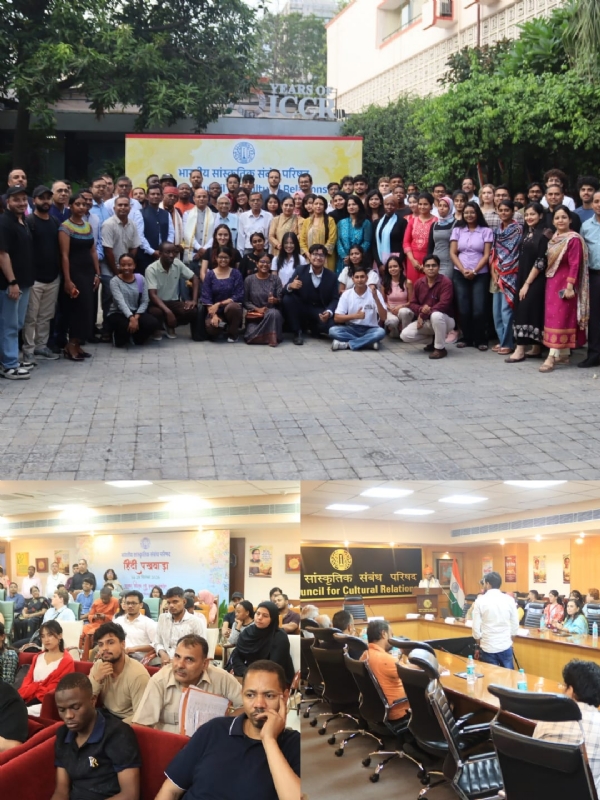
New Delhi, 29 September (H.S.): Students from three countries secured the first, second and third positions in a Hindi essay-writing competition held as part of the 14-day ‘Hindi Fortnight Closing Ceremony’ organised by the Indian Council for Cultural Relations (ICCR) in New Delhi. Students from 30 countries participated in the programme and shared their deep affection for India as well as their experiences of living and studying in the country.
According to the ICCR, the theme of Monday’s programme was ‘India Resides in My Heart’. All the participating students are pursuing studies at different universities across India under ICCR scholarships. In the Hindi essay-writing competition, Janudi Weerarave of Sri Lanka won the first prize, Sabrina of Uzbekistan secured the second prize and Valeria of Ukraine won the third prize. Consolation prizes were awarded to participants from Uzbekistan, Bangladesh and Nepal. Speakers at the event delivered thought-provoking addresses on the rich cultural dimensions of Hindi, human values and the language’s growing global reach.
On the occasion, international students said, “India resides in our hearts. We have experienced it not merely as a country, but through education, culture, music, yoga, art and human relationships.”
Addressing the ceremony virtually, Union Home and Cooperation Minister Amit Shah said India’s linguistic diversity is not a weakness but one of the country’s greatest strengths and a valuable form of cultural capital. He emphasised that the global dissemination of yoga, Ayurveda and India’s knowledge traditions can be most effectively achieved through the country’s languages.
ICCR Director General K. Nandini Singla said Hindi is not merely a language of communication but a global bridge connecting India’s culture, sensibilities and diversity with the wider world. She said the active participation of international students strengthens India’s cultural diplomacy globally. The ICCR’s broader objective, she added, is to take India’s spiritual and peace-oriented message to people around the world through yoga, meditation, classical music and the arts. The ICCR officially identifies K. Nandini Singla as its Director General.
ICCR Deputy Director General Dr. Rajesh Ranjan emphasised that the fundamental purpose of the initiative was “to move beyond files and connect hearts”. He said Hindi was no longer confined to the banks of the Ganga, but was flowing as far as the banks of the Volga, Rhine and Amu Darya. The international spread of Hindi through these students, he said, would take the cultural relationship between India and the wider world to a new level. The ICCR lists Dr. Rajesh Ranjan as Deputy Director General responsible for Conference, Research, Special Projects and Scholarships.
Seven Padma Shri awardees from the fields of art, culture, music, literature and medicine participated in the closing ceremony. On the occasion, 10 distinguished personalities from the literary, artistic and medical fields, including Padma Shri awardees, were honoured by C&SP for their outstanding contributions. They included Padma Shri Prof. Ashok Chakradhar, Padma Shri Dr. Ranjana Gauhar, Padma Shri Dr. Jatin Das, Padma Shri Dr. Mohsin Wali, Padma Shri V. S. Mehta, Padma Shri Dr. Dinesh Bhargava, Padma Shri Dr. Purushottam Dadhich (Puru), Padma Shri Bheru Singh Chauhan, Prof. Vimlesh Kanti Verma and Anita Verma. The distinguished guests interacted directly with the international students and shared experiences and insights with them. For the first time, international students were given a special place in the Hindi Fortnight programme, which ran from September 14 to 28.
Students from Uzbekistan, Ukraine, Russia, Sri Lanka, Bangladesh, Nepal, Egypt, Costa Rica, Kazakhstan, Lesotho, Tajikistan, Bhutan, Myanmar and China studying at leading institutions including the University of Delhi, Delhi Technological University and Guru Gobind Singh Indraprastha University attended the programme.
Among the participants were Zilola, Sabrina, Valeria and Diana, research scholars from Uzbekistan and Ukraine pursuing PhDs in Hindi at the University of Delhi, who shared their thoughts in Hindi. Special video messages from Hindi enthusiasts associated with international centres in Germany and Japan were also screened during the event.
Certificates and prizes were also presented on stage to the winners of competitions such as ‘India Resides in Me’ and the Hindi essay-writing contest. Janudi Weerarave of Sri Lanka received the first prize in the Hindi essay competition, followed by Sabrina of Uzbekistan in second place and Valeria of Ukraine in third. Consolation prizes were awarded to participants from Uzbekistan, Bangladesh and Nepal, while certificates of appreciation were presented to other outstanding participants from Ukraine, Uzbekistan, Bangladesh, Nepal and Tajikistan.
Students from Iran, Cambodia, Thailand, Bangladesh and Nepal also demonstrated their talent in the online and international writing competition.
The event emerged as a notable expression of India’s soft power and cultural diplomacy, bringing together students from different parts of the world and highlighting Hindi as a language capable of fostering cultural understanding and a sense of global fellowship.
---------------
Hindusthan Samachar / Jun Sarkar
18 Aug 2026