Accurate, timely and verified data basis of effective policy
making: Yogendra Upadhyay
Institutions should ensure accuracy and authenticity of data: Higher Education
Minister
Data collection should not be a formality, but should be considered responsibility
for policy and planning: Higher Education Minister
Accurate, timely and verified data basis of effective policy-planning of higher
education: Higher Education Minister Yogendra Upadhyay
Lucknow, 28 Sept (HS): State Higher Education Minister Yogendra Upadhyaya
stated that accurate, timely, and verified data related to higher education is
not merely a collection of statistics, but a crucial basis for effective policy
making, planning, and understanding the actual state of the higher education
system. Data alone can determine where new institutions are needed, where
teachers and resources are needed, and in which areas special efforts should be
made for development. This means that the proper formulation of future
programs, plans, and policies depends on data.
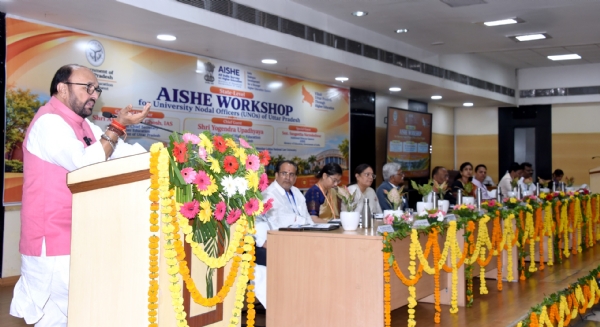
The Higher Education Minister was addressing university nodal officers at the
state-level AISHE (All India Survey on Higher Education) workshop held at Dr.
Ram Manohar Lohia National Law University, Lucknow, on Monday. The workshop was
organized by the Higher Education Department, Uttar Pradesh, in coordination
with the Ministry of Education, Government of India. Discussions focused on
data collection, verification, submission, analysis, and strengthening
institutional mechanisms.
Minister Upadhyay said that data reflects society and the higher education
system. The Government of India and the State Government make many important
decisions based on available data. Therefore, data collection should not be
considered a routine process but a responsibility for policy and plan
development. If the data is accurate, plans will be more effective.
He stressed on the need for universities to regularly update the AISHE data of
affiliated colleges and institutes. He said that many institutes do not provide
the data on time after receiving the AISHE code, due to which their status may
become inactive and this affects the students. The nodal officer should conduct
regular reviews. Avoid the tendency of waiting for the last date after the
portal opens, ensure verification by obtaining the data in time. Information
regarding enrollment, vacancies, courses, examinations, results, infrastructure
should be entered only after verifying it with the original records. Merely
filling the data is not enough, its accuracy and authenticity should also be
ensured.
The Higher Education Minister said that the role of nodal officers should not
be limited to mere collection. Cross-verification should be done before final
approval, random verification should be done as per requirement to check the
authenticity of records and AISHE data, and technical-administrative support
should also be provided to the institutions. The state's efforts should be
towards zero pendency. No eligible and functioning institution should be left
out of the survey due to administrative negligence. He said that in the digital
age, it is essential to have correct information available at the right time.
By identifying future needs from data, better planning can be done for new
institutions, faculties and departments. Data planning should not be considered
a formality but a responsibility of policy planning.
Speaking on the occasion, Additional Chief Secretary, Higher Education, Amit
Kumar Ghosh, stated that data management for AISHE is not just the
responsibility of the nodal officer, but of the entire institution. Data comes
from various departments, including admissions and examinations, so
institutional arrangements are essential for reliability. Based on the
workshop's suggestions, an SOP will be developed and submitted for approval. He
emphasized the need for consistency between university records and AISHE
records, reconciliation of affiliation lists, verification of authentic records
to avoid misreporting and double reporting, and in-depth review of unusual
changes. Uploading data is a process, but analyzing and gap analysis is more
important.
In the workshop, Director Higher Education Prof. Monika Singh presented her
views on systematic collection and quality of data. RMLNLU Vice Chancellor
Prof. Dr. Amar Pal Singh, Director AISHE Additional Director General Sangeeta
Narmadeshwar, Registrar Keshav Kumar, State Nodal Officer AISHE Prof. Dinesh
Chandra Sharma, Additional Secretary of Higher Education Council Dr. Dinesh K.
Rajput along with other officials and nodal officers of the universities of the
state were present in the workshop. Information related to DCF and AISHE portal
was given in the technical sessions and university-specific problems were
discussed.
Hindusthan Samachar / Abhishek Awasthi
18 Aug 2026
ED raids KPSC office, 20 other locations over Karnatak veterinary recruitment scam
ED raids KPSC office, 20 other locations over Karnatak veterinary recruitment scam..