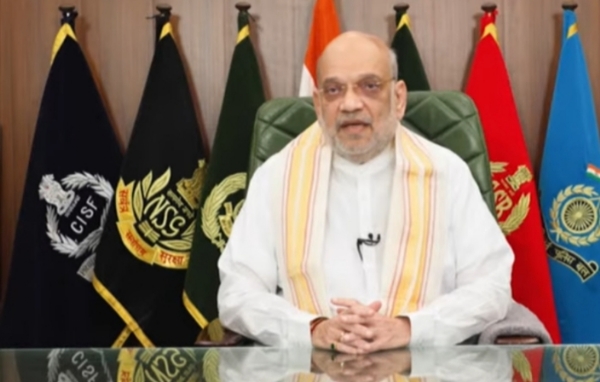
New Delhi, 28 September (H.S.): Union Home and Cooperation Minister Amit Shah on Monday said India’s linguistic diversity is not a weakness but the country’s greatest strength and cultural capital. He said the global spread of yoga, Ayurveda and Indian culture has been made possible through the country’s languages.
Shah delivered a virtual message at the concluding ceremony of Hindi Pakhwada organised at the Indian Council for Cultural Relations (ICCR) in New Delhi. The theme of the programme was “India Resides in My Heart”. Speakers at the event delivered insightful addresses on Hindi’s rich cultural context, human sensibilities and global outreach.
The Union Minister said, “Hindi is not a competitor to any regional language; rather, it is the strongest link for dialogue, communication and coordination among all Indian languages. Language is not merely a means of communication; it embodies a society’s memory and sense of self. Hindi can develop fully only when it advances alongside the respect, preservation and promotion of all the languages of the country.”
He made a special appeal to young people and parents to learn languages from around the world but never abandon their mother tongue. He said feeling inferior or developing an inferiority complex about speaking one’s language is a major mistake, as language connects an individual with their roots, history and culture.
Shah underlined that history bears witness to the significant role played by personalities whose mother tongues were not Hindi in making Hindi a medium of mass communication. Swami Dayanand Saraswati, a Gujarati speaker, wrote his seminal work Satyarth Prakash in Hindi. Mahatma Gandhi established the Dakshina Bharat Hindi Prachar Sabha in Madras in 1918. Netaji Subhas Chandra Bose, a Bengali speaker, adopted Hindi as the language of communication of the Azad Hind Fauj and gave the country the immortal slogan “Jai Hind”. He said that after Independence, the issues of one’s own language, culture and self-respect remained neglected for a long period.
He said that the old laws enacted during the British era have been replaced by three people-centric laws — the Bharatiya Nyaya Sanhita, the Bharatiya Nagarik Suraksha Sanhita and the Bharatiya Sakshya Adhiniyam. Under the new National Education Policy (NEP), higher education and competitive examinations, including medical and engineering examinations, are now being conducted in Indian languages. He said language is the most prominent foundation of India’s soft power under the “Saptadhara of Shakti” announced on the 78th Independence Day.
Rejecting concerns that Indian languages could fall behind in the era of technology, Shah said technology and artificial intelligence (AI) have helped Indian languages enter a golden era. AI-based tools developed by the Department of Official Language are facilitating communication between different languages. The digital dictionary “Hindi Shabd Sindhu”, containing more than 8.27 lakh entries, has emerged as an important medium for knowledge sharing.
The Bharatiya Bhasha Anubhag, established in 2024, is facilitating administrative work in regional languages. The Committee of Parliament on Official Language has also submitted four new volumes of its reports to the President.
Referring to the 150th anniversary of the composition of the national song “Vande Mataram”, the Union Minister called upon citizens to resolve to make Hindi and all Indian languages powerful instruments in building a Viksit Bharat by 2047.
On the occasion, 10 eminent personalities from the fields of literature, art and medicine, including Padma Shri awardees, were honoured by C&SP for their outstanding contributions. The awardees included Padma Shri Prof. Ashok Chakradhar, Padma Shri Dr Ranjana Gauhar, Padma Shri Dr Jatin Das, Padma Shri Dr Mohsin Wali, Padma Shri V.S. Mehta, Padma Shri Dr Dinesh Bhargava, Padma Shri Dr Purushottam Dadhich (Puru), Padma Shri Bheru Singh Chauhan, Prof. Vimlesh Kanti Verma and Anita Verma.
---------------
Hindusthan Samachar / Jun Sarkar
18 Aug 2026