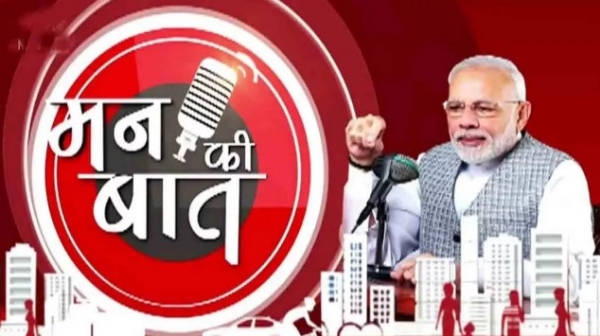
New Delhi, 27 September (H.S.): Prime Minister Narendra Modi, in his ‘Mann Ki Baat’ programme, appealed to people to increase their participation in the Census, describing it as a national responsibility of every citizen. He also reiterated India’s zero-tolerance policy against terrorism, saying that the 2016 surgical strike was a symbol of India’s decisive approach towards terrorism and that today’s India possesses both the capability and the resolve to deliver a befitting response to terrorism.
Prime Minister Narendra Modi, in the 138th episode of his monthly radio programme on Sunday, said that the first phase of the Census in the country is almost complete and data of more than 32 crore families has already been recorded. He said that the Census exercise is also continuing in remote and snowbound areas of Ladakh, Himachal Pradesh, Jammu and Kashmir and Uttarakhand. Referring to Mana village in Chamoli district of Uttarakhand, he said the Census process there began with 83-year-old Purnima Rawat, while in Bagori village of Uttarkashi, homestay operator Hardev Singh Rana entered his details himself through the digital platform.
The Prime Minister advised people to make use of the self-enumeration facility available for the Census. He said citizens can visit the Census portal on their mobile phones and enter details about themselves and their families. The facility is available in 16 languages, including Hindi. He said more than 2.6 crore people have so far entered their details themselves. The process can be completed in just 15 to 20 minutes and there is no need to upload any documents. After submitting the details, a special identification number is issued, which can be shared with the enumerator.
The Prime Minister said an accurate Census forms the basis for preparing a correct picture of a country’s future. He appealed to people to actively participate in the exercise in the national interest.
During the programme, Prime Minister Modi also referred to the 10th anniversary of the surgical strike conducted on September 28-29, 2016. He said the Indian Army had crossed the Line of Control and carried out operations against terrorist launch pads located in Pakistan, and the entire world was astonished to witness the action by Indian soldiers. The surgical strike presented a new example of India’s counter-terrorism policy before the world.
The Prime Minister said India had suffered for a long time due to terrorist attacks. There was a time when a series of bomb blasts had become a common occurrence in the country. Recalling the serial blasts in Delhi on September 13, 2008, followed a few weeks later by the November 26, 2008, Mumbai terror attacks, he said that during that period, demands for action were raised after terrorist incidents, but often there was merely an expectation that time would pass. Over the past decade, from the surgical strike to the Balakot air strike and Operation Sindoor, India has repeatedly made it clear that if terrorists cast an evil eye on India, they will receive a befitting response. Today, India is following a policy of complete zero tolerance towards terrorism, and its results are also visible. The Prime Minister also referred to the 25th anniversary of the September 11, 2001, terrorist attacks in the United States. He said that after Americans, the highest number of Indian citizens lost their lives in the attack on the World Trade Center.
Prime Minister Modi paid tribute to former international president of the Vishva Hindu Parishad, Ashok Singhal, on his 100th birth anniversary. He said Ashok Singhal lived like an ascetic while remaining actively engaged in society. The direction and energy he provided to the Ram Janmabhoomi movement are reflected today in the form of the grand Ram Temple in Ayodhya. Despite belonging to an affluent family and having been educated at the Indian Institute of Technology, Banaras Hindu University, Ashok Singhal devoted his entire life to society and culture.
The Prime Minister also mentioned the ‘Somnath Swabhiman Parv’. He said that in 1026, Mahmud Ghazni destroyed the Somnath temple, but the identity and faith of India could not be erased. The Sun Temple at Modhera in Gujarat was also attacked in the same year. At that time, King Bhimdev I not only confronted the invaders but also rebuilt the temple within a short period. In a later period, Alauddin Khilji too destroyed the temple, but the rebuilding spirit of Indian society kept it alive.
The Prime Minister said that today Modhera is known not only for the Sun Temple but also as the country’s first ‘solar village’. The entire village is powered by solar energy, and several facilities have been developed there for tourists. He urged people to visit Modhera and witness this heritage of India.
Prime Minister Modi, while referring to efforts related to history and culture in Tamil Nadu’s Tiruchirappalli district, said that A. Selvaraju, associated with the Department of Tamil Studies, has been conducting field visits with students and has discovered several ancient idols and temples. Such efforts help in understanding the country’s cultural heritage.
Prime Minister Modi said cleanliness is a true tribute to Bapu. He appreciated river-cleaning campaigns in Madhya Pradesh, efforts to preserve ancient stepwells and wells in Andhra Pradesh, beach-cleaning drives in Mumbai, waste segregation initiatives in Delhi and cleanliness campaigns in market areas of West Bengal. He said all these campaigns reflect the spirit of public participation.
He cited environmental conservation efforts in Assam’s Sonai Rupai Wildlife Sanctuary, where elephants have returned after encroachments were removed. He also mentioned the pygmy hog conservation programme, which began with six animals and has now increased their number to more than 190. The Prime Minister also praised women in the Sundarbans region of West Bengal who are developing mangrove forests. He said many of these women had lost their husbands in tiger attacks, but today they are developing mangroves, providing natural protection to their villages while also earning their livelihoods.
Prime Minister Modi mentioned the ‘Drug-Free Youth Campaign’ and said millions of young people across the country have pledged to stay away from drugs and create awareness among others about the dangers of substance abuse. The campaign will continue for 100 weeks and involves ‘MY Bharat’, the National Service Scheme, schools, colleges, universities and several social and spiritual organisations. The Prime Minister mentioned former Olympian Rajinder Singh of Punjab. He said Rajinder Singh, who was part of the team that won the Olympic gold medal in 1980, is now working in rural areas to identify and train hockey talent. His efforts have resulted in the development of new astroturf grounds, and several players have reached the national level.
The Prime Minister said that under the ‘One District, One Product’ scheme, around 100 amla-based processing units are operational in Uttar Pradesh’s Pratapgarh. Women associated with organisations such as the Savitri Phule Self-Help Group and Vindhyavasini Self-Help Group are making amla candy, murabba, juice, pickles and digestive powder. With access to new markets, machinery and credit facilities, their incomes have increased significantly.
The Prime Minister also referred to the Ganesh festival celebrated across the country and spoke about Panthoun Thirkanon of Thailand. He said his devotion to Lord Ganesha inspired him to establish the Ganesh Himalaya Museum in Chiang Mai. The museum houses more than 10,000 idols of Lord Ganesha and also promotes the Ashtavinayak tradition. This is an example of the global influence of India’s faith, art and culture.
Hindusthan Samachar / Jun Sarkar
18 Aug 2026