New Delhi, 26 September (H.S.):
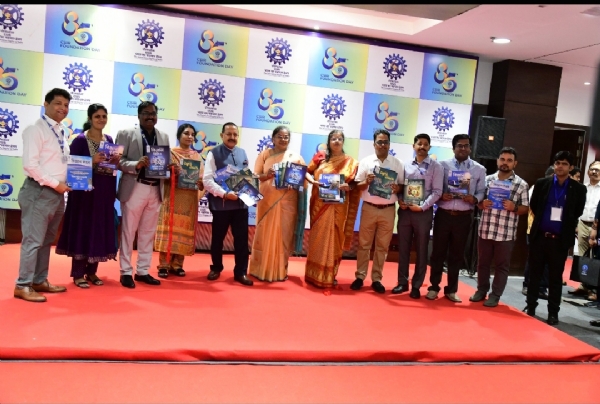
The Council of Scientific and Industrial Research (CSIR) has taken a significant step towards making scientific information accessible to a wider section of society in people’s own languages. Union Minister of State (Independent Charge) for Science and Technology, Dr. Jitendra Singh, launched a set of new popular science magazines in five Indian languages on the occasion of CSIR’s 85th Foundation Day.
The magazines, launched by CSIR’s National Institute of Science Communication and Policy Research (CSIR-NIScPR), will be published in Tamil, Telugu, Marathi, Bengali and Assamese. They include ‘Vigyan Lehar’ in Assamese, ‘Vigyan Vrittant’ in Bengali, ‘Vigyan Kshitij’ in Marathi, ‘Ariviyal Arikkaiyalar’ in Tamil and ‘Vigyan Velugu’ in Telugu.
The initiative expands CSIR-NIScPR’s long-standing tradition of science communication. The institute’s established science magazines include the English-language ‘Science Reporter’, Hindi’s ‘Vigyan Pragati’ and Urdu’s ‘Science Ki Duniya’. CSIR-NIScPR is the organisation’s national institute dedicated to science communication and policy research.
A key feature of the new magazines will be the use of modern technologies such as artificial intelligence (AI). Selected content from CSIR-NIScPR’s existing science magazines will be translated into various Indian languages with the assistance of AI. Human experts will then review, proofread, fact-check and edit the translated material to ensure scientific accuracy and maintain high standards of language and presentation.
Alongside translated material, the magazines will also publish original articles in the respective Indian languages. The initiative is expected to encourage science writing in regional languages and help bring scientific achievements, innovations and technological developments from different parts of the country to a wider readership.
CSIR Director General and Secretary, Department of Scientific and Industrial Research (DSIR), Dr. N. Kalaiselvi, and CSIR-NIScPR Director Dr. Geetha Vani Rayasam, along with the editors and editorial teams of the respective magazines, were present at the event. CSIR records confirm Dr. N. Kalaiselvi as Director General of CSIR and Secretary, DSIR, while CSIR-NIScPR identifies Dr. Geetha Vani Rayasam as its director.
Dr. Geetha Vani Rayasam said the launch of the five new magazines aims to take science to a broader section of society and contribute to building a multilingual, inclusive and scientifically aware India. CSIR-NIScPR has also highlighted the use of AI for communication in regional languages as part of its broader science-communication efforts.
---------------
Hindusthan Samachar / Jun Sarkar

18 Aug 2026