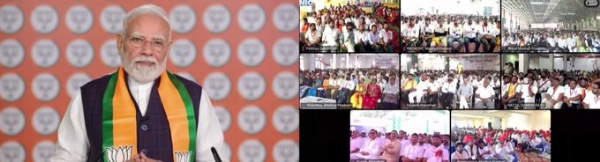
New Delhi, 25 September (H.S.): Prime Minister Narendra Modi on Friday told participants of the ‘Seva Sankalp Abhiyan’ that the experiences they gain by connecting with people and undertaking service activities in villages across different states during the journey would become an invaluable asset in their lives. He told the youth that India’s diversity, the culture of its villages and the spirit of community service cannot be fully understood through books alone; it is necessary to travel from village to village and spend time among the people. Modi also urged the participants to write down and document their experiences throughout the journey.
Interacting through videoconferencing with a group travelling from Vadnagar to Varanasi under the ‘Seva Sankalp Abhiyan’, the Prime Minister said that over the past 10-12 years, there had been significant improvements in infrastructure and basic amenities in villages, considerably narrowing the gap between urban and rural areas. Referring to initiatives such as Namo Drone Didi and Lakhpati Didi, he asked the participants whether they could feel the changes taking place in villages and whether rural residents themselves discussed these changes. He said the journey was giving young people an opportunity to witness these transformations firsthand and interact directly with the people.
Modi also advised the Seva Yatris to pay attention to their safety. Referring to the saffron scarves worn by the participants during the interaction, he said in a light-hearted manner, “You don’t wear this scarf while riding a bike, do you? You wear a helmet, right? Don’t mistake the scarf for a helmet.” He also suggested that the participants remain in touch with their families, connect with people in the areas they pass through, exchange contact numbers and create WhatsApp groups.
The Prime Minister remembered Pandit Deendayal Upadhyaya on his birth anniversary. Referring to seven principles associated with duties in social life — the spirit of service, balance, restraint, coordination, positivity, empathy and dialogue — he said these principles represented the essence of the Seva Sankalp Yatra. He said that distributing educational materials to children in villages, planting trees, serving the elderly, reaching out to women and understanding the aspirations of young people may appear to be different activities, but they are united by the common spirit of serving society with humanity at the centre.
Referring to the life of Mahatma Gandhi, Modi said Gandhi worked not only for the freedom movement but also for social reform and consistently raised his voice against social evils. He said continuous efforts should be made to bring about positive change in society. He said that one should not simply focus on one’s own vote bank and allow everything else to continue as it is. Referring to the contribution of sanitation workers, he said those who work to keep society clean should be respected. He also recalled the occasion in Prayagraj when sanitation workers were honoured by washing their feet, saying that their work had enhanced India’s dignity.
Referring to Deendayal Upadhyaya’s philosophy of Integral Humanism, Modi said that the development of an individual cannot be separated from the development of society and the nation. He said the development of society should not come at the cost of nature and the benefits of national development should reach the last person in society. He said this spirit of service leads to the idea of Antyodaya — the upliftment of the last person.
Modi said the path to success is built through small, incremental efforts and that the achievement of these smaller objectives ultimately makes it possible to accomplish larger goals. He urged the Seva Yatris to write down and record the experiences they gain during the journey, saying these experiences would prove highly valuable after the journey was over. He noted that each group currently comprised around 20 people, but when the groups reached Vadnagar and Kashi, there would be around 500 people on each side. He suggested that everyone sit together for two to three hours and share their experiences.
The Seva Sankalp Yatra is passing through 193 districts, 773 tehsils and 10,159 villages across 10 states, including Uttar Pradesh, Bihar, Jharkhand, Chhattisgarh, Madhya Pradesh, Maharashtra, Rajasthan, Haryana, Delhi and Gujarat. Around 25 types of service activities are being undertaken during the journey, including tree plantation, cleanliness drives, fruit distribution, medical assistance, distribution of kits and pledges for organ donation. As of September 25, 20 groups had collectively covered 13,733 kilometres, while the groups travelling from Varanasi to Vadnagar had completed a distance of 5,961 kilometres.
The Prime Minister said the Seva Sankalp Yatra was like a river that connects everyone. A river does not ask which language a person speaks, which family they belong to or what their economic status is; it gives new life to everyone. Similarly, he said, the Seva Yatra is connecting with people and advancing the spirit of moving from public welfare to the welfare of humanity at large.
He urged the Seva Yatris to prioritise their safety, remain in contact with their families and connect with as many people as possible during the journey.
---------------
Hindusthan Samachar / Jun Sarkar

18 Aug 2026