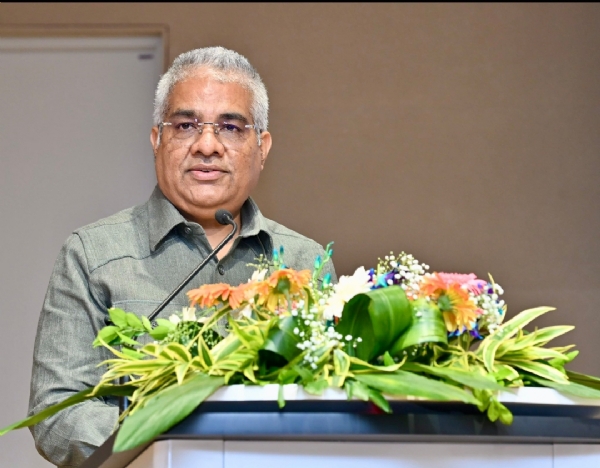
New Delhi, 25 September (H.S.): Union Minister for Environment, Forest and Climate Change Bhupender Yadav said on Friday that capacity building tailored to the needs and local conditions of each region is essential for making forest management more effective. He said training programmes should integrate local knowledge with scientific approaches and emerging technologies.
Inaugurating a workshop on the ‘Capacity Enhancement for Effective Forest Management Project’, organised on Friday with the support of the Japan International Cooperation Agency (JICA), Yadav said forests are critically important for addressing climate change, conserving biodiversity and sustaining the livelihoods of communities dependent on forests. Therefore, there is a need to strengthen the capacities of frontline forest personnel at both operational and administrative levels.
He said forest fire management has emerged as a global challenge. In this context, the project can help strengthen technical and field-level capabilities in forest fire management, biodiversity conservation and climate action. He emphasised that capacity building should not be confined to classrooms, but should incorporate modern technologies and successful field-level practices into training programmes.
The Minister stressed the need to develop region-specific capacity-building modules. He said these modules should incorporate local knowledge and regional challenges. Under the project, activities will include research and development to devise practical technical solutions, pilot projects for the field-level application of technologies, and strengthening of training institutions. Emphasis will also be placed on sharing best practices with SAARC and other developing countries.
JICA India Senior Representative Eiji Wakamatsu said the project would bring Indian and Japanese research institutions together and provide a platform for developing solutions to global challenges related to forest management, climate change and capacity building. He said JICA’s partnership with India in the forestry sector dates back nearly three decades and has benefited more than seven lakh people. During the second phase of the project, special attention will be given to the better utilisation of wood and livelihood generation, improving forest management through digital technologies, and joint academic research.
During the workshop, a booklet outlining the project framework and key areas of cooperation was also released. In the technical session, the Ministry provided an overview of the project’s objectives and scope. JICA representatives subsequently shared their perspectives, followed by an interaction with representatives from states, research institutions and central training institutions.
The seven-year project will run from 2025-26 to 2031-32, with a total budget of Rs. 537.10 crore. Of this, JICA will contribute Rs. 440.42 crore, while the Government of India will contribute Rs. 96.68 crore. The project will cover all states across the country. While priority will be given to new states, support will also be extended to states covered under the previous related project.
---------------
Hindusthan Samachar / Jun Sarkar

18 Aug 2026