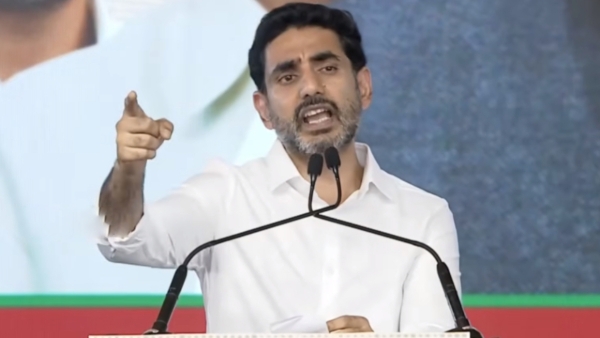
New Delhi, 25 September (H.S.): Andhra Pradesh has revised school textbooks to remove gender stereotypes and promote respect for women among children from an early age, state Human Resources Development and IT Minister Nara Lokesh said on Thursday.
Speaking at a fireside chat organised by the Public Affairs Forum of India (PAFI) in New Delhi, Lokesh outlined ongoing reforms in school and higher education, focusing on value-based learning, gender sensitivity, technology-enabled education, curriculum reform and industry-linked skill development.
He said the state was reviewing the courses, majors and minors offered in higher education to assess their relevance and alignment with market requirements.
Lokesh said textbooks for Classes 1 and 2 earlier depicted household chores as being performed entirely by women. The state has now changed the approach so that household activities shown in the textbooks are equally divided between men and women, with the aim of avoiding gender stereotyping from the first grade.
He said Saturdays are observed as No Bag Day in schools, providing opportunities for value-based and practical learning. Activities include lessons on managing family and agricultural budgets, field visits and introduction to Artificial Intelligence.
Students are being taught about both the positive and negative aspects of AI so that they can understand the technology and use it effectively, he said.
On curriculum reform, Lokesh said Andhra Pradesh had already undertaken two rounds of curriculum improvement. He said the process would be carried out incrementally and systematically, with grade-wise improvements and continuous additions.
Lokesh also outlined a plan to make classroom learning more interactive through technology. Under the proposed approach, students would watch a 60- or 90-second video summarising a lesson after every 45-minute class, followed by four to five questions. Clicker technology would enable students to answer the questions and participate actively in the learning process.
The objective, he said, was to shift students from passive learners to active participants. Learning data would be integrated into the state's Learning Management System (LMS) to identify individual learning gaps and provide targeted homework and learning material.
Lokesh cited the example of a student who performs well in mathematics but has difficulty with a specific concept such as probability. The system would identify the gap and provide additional learning material and homework through the LEAP app, which is accessible to parents and teachers.
---------------
Hindusthan Samachar / Indrani Sarkar

18 Aug 2026