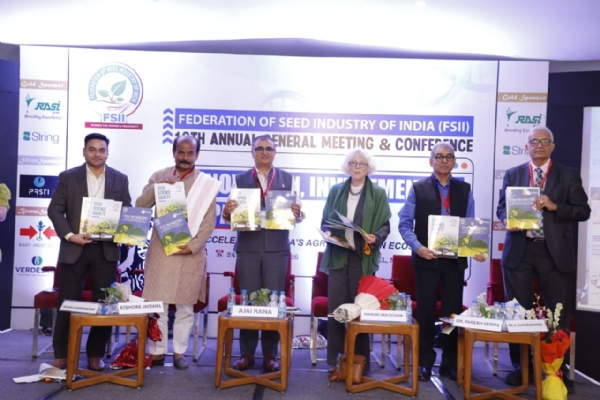
New Delhi, 24 September (H.S.): The Federation of Seed Industry of India (FSII), the leading industry association representing research- and development-driven plant science and seed companies in India, said on Thursday that the Indian seed industry aims to increase the country’s share of global seed trade from around 1% currently to 10% by 2035. The industry also seeks to strengthen domestic innovation and self-reliance in strategically important crops such as oilseeds and pulses.
The FSII announced the target during FSII Knowledge Day 2026, organised in New Delhi as part of its 10th Annual General Meeting. The association said the Indian seed industry, currently valued at around $3.6 billion, is expected to grow to more than $5 billion by 2030. It said the expansion would contribute to the vision of “Aatmanirbharta” (self-reliance) advocated by Prime Minister Narendra Modi.
FSII Chairman and Savannah Seeds Managing Director and Chief Executive Officer Ajay Rana said India has the scientific expertise, talent and farmer base required to emerge as a significant force in the global seed market. He said government initiatives, including the National Mission on High-Yielding Seeds, represent important steps in this direction.
“India has the science, talent and farmers needed to become a major force in the global seed market. Government initiatives such as the National Mission on High-Yielding Seeds are important steps. The industry is ready to increase investment in research, particularly in oilseeds and pulses,” Rana said.
Highlighting the industry’s regulatory requirements, Rana called for a single national framework for seed regulation with defined timelines. He said approvals for new varieties, traits and technologies should be faster and based on scientific assessment, while intellectual property protection should also be strengthened, particularly for oilseeds and pulses.
According to Rana, a predictable regulatory framework and stronger intellectual property protection would give companies greater confidence to make long-term investments in research and development.
He said the industry believes that increasing investment in research and development would generate significant benefits for the economy because innovation is directly linked to economic growth. Rana noted that developed countries generally spend around 3-4% of their GDP on research and development, while India’s investment remains below 1%.
Citing industry research, he said every rupee invested in R&D could potentially generate a return of Rs. 13.
Rana also stressed the need for closer cooperation between the government and the seed industry. Referring to India’s dependence on imports of edible oils, he said the country could achieve self-reliance in edible oils in less than a decade if the government and industry work together.
He said the industry had developed hybrid mustard varieties capable of producing around one tonne per acre, which could substantially improve farmers’ incomes. He suggested that shifting part of the cultivated area from wheat to mustard could help raise farm incomes while also reducing India’s dependence on edible-oil imports.
Rana also highlighted the contribution of Bt cotton to Indian agriculture, stating that around 99% of the country’s cotton area has shifted to Bt cotton. He said maize production, which was earlier around 12 million tonnes, has now risen to nearly 50 million tonnes, while India’s rice exports have reached 22 million tonnes.
During the event, FSII officials and guests also launched the newsletter of the Seed Science Society.
FSII Director General Dr. Paresh Verma, Satguru Management Consultants Chairman and CEO Dr. K. VijayRaghavan, progressive farmer Kishore Jaiswal and other representatives of the federation were present at the programme.
---------------
Hindusthan Samachar / Jun Sarkar

18 Aug 2026