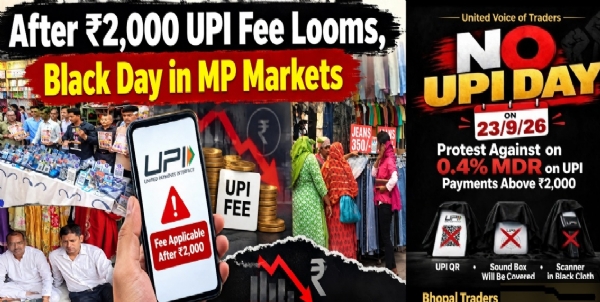
Bhopal, 23 September (H.S.): Traders took to the streets across markets in Madhya Pradesh on Wednesday to protest against the proposed charge on UPI payments above ₹2,000. A ‘No-UPI Day’ was observed in several cities, including Bhopal, Indore, Gwalior, Ujjain and Jabalpur. UPI QR scanners and sound boxes at shops were covered with black cloth, symbolic effigies of UPI were hung at some places, and customers were asked to pay cash for transactions above ₹2,000.
In Indore, more than 150 traders staged a demonstration at Regal Square. In Gwalior, traders stopped both accepting and making payments through UPI. In Jabalpur, organisations distributed leaflets appealing to the public to support the campaign. In Ujjain, however, UPI transactions continued as normal. The protest has been triggered by the proposed Merchant Discount Rate, or MDR, of 0.4 per cent on UPI payments above ₹2,000 made by individuals to merchants from 15 October. A maximum charge of ₹300 has been proposed for transactions of ₹75,000 or more. Payments up to ₹2,000 will remain outside the scope of the charge.
Demonstration from Rajwada to Regal Square in Indore
In Indore, traders in the Rajwada area put up posters at their shops demanding withdrawal of the proposed charge. QR scanners and sound boxes were covered with black cloth. The Tiles and Sanitaryware Traders Association staged a demonstration at Regal Square, which was attended by more than 150 traders. Slogans such as ‘Stop UPI, Stop Charges on UPI’ were raised.
Retail garment traders in Indore also participated in the protest. Kailash Chandra Khandelwal, a member of the Ahilya Chamber of Commerce, called on the government to reconsider the proposed charge. Traders said the additional cost would affect business margins and could also have an impact on prices.
Protest visible in wholesale markets of Bhopal
In the wholesale grocery, medicines, bullion, textile and iron markets of the old city of the state capital Bhopal, the impact of the protest was visible. In Chowk market, traders put black strips on QR codes and hung a symbolic UPI effigy. At several shops, payments for bills above ₹2,000 were accepted in cash.
Wholesale grocery traders said their businesses involve a large number of high-value transactions. Anupam Agrawal, General Secretary of the Pradesh Vyapar Mandal, said he estimated that more than 90 per cent of transactions in the wholesale grocery business were above ₹2,000. A 15-litre jar of cooking oil costs around ₹2,200. In such cases, traders said, the proposed MDR on UPI payments would increase their costs.
The impact of the protest remained limited in Bhopal's New Market, 10 Number Market, Bittan Market, Kolar Road, Hoshangabad Road, Bawadiakalan, Raisen Road and Awadhpuri. UPI payments continued normally in these areas.
Ajay Dewani, spokesperson for the Bhopal Chamber of Commerce, demanded withdrawal of the proposed charge. CAT district president Dharmendra Sharma said traders were not opposed to UPI, but to the additional cost arising from the MDR. He said that if the charge was to be recovered from traders, it should be termed a ‘Merchant Tax Rate’ instead of an MDR.
Wholesale grocery traders in Bhopal said that if the amount was deducted from a merchant's account, it would affect profits. Businesses would then have the option of adjusting the cost within their margins or incorporating it into prices. Traders said the latter could have an impact on consumers.
Gwalior stops both accepting and making UPI payments
In Gwalior, traders stopped both accepting and making payments through UPI. Black strips were placed over QR codes at shops. Referring to existing taxes, including GST and income tax, traders said businesses were already bearing the cost of various taxes. An additional digital payment charge would increase costs further. Some traders also expressed concern that higher costs associated with digital payments could encourage cash transactions. Traders called on the government to reconsider the proposed charging mechanism.
Leaflets distributed in Jabalpur, business remains normal in Ujjain
In Jabalpur, the Nagarik Upbhokta Manch, Manav Adhikar Kranti and various other organisations distributed leaflets at Malviya Chowk. The public was urged to support ‘No-UPI Day’. The organisations said that any additional cost imposed on traders could ultimately reach consumers through market prices. The situation was different in Ujjain. Various traders' organisations and the Petrol Pump Business Association denied organising any formal protest. UPI payments continued normally in the city. Local residents demanded that UPI payments up to ₹50,000 be kept exempt from the charge.
Wholesale traders most concerned
According to traders, the proposed MDR would directly increase costs in low-margin businesses. A 0.4 per cent charge amounts to ₹8 on a ₹2,000 payment, ₹40 on ₹10,000 and ₹300 on ₹75,000. The proposed maximum charge would remain ₹300 even for transactions above ₹75,000. Under the proposed system, MDR would not apply to UPI payments up to ₹2,000.
The government has also said that the proposed charge is not intended to be collected directly from customers. Stakeholders involved in the payments system argue that the charge is focused on higher-value transactions, while smaller payments remain outside its scope.
The objection raised by traders' organisations centres on regular high-value business payments. They say that in wholesale grocery, medicines, bullion, textiles and other businesses, payments above ₹2,000 are part of everyday sales. As a result, the cumulative impact of a per-transaction cost could affect business margins.
For now, Wednesday's ‘No-UPI Day’ has emerged in Madhya Pradesh with varying levels of impact across different cities and markets rather than as a uniform statewide protest. Attention will now remain on discussions between traders' organisations and other stakeholders ahead of the proposed system coming into effect from 15 October.
---------------
Hindusthan Samachar / Mayank Chaturvedi
18 Aug 2026