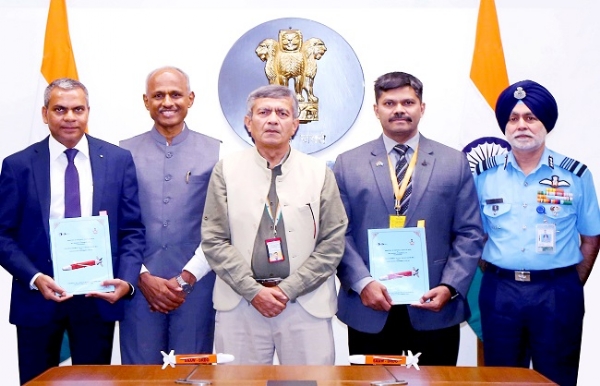
-SAAW System to Enable Indian Fighters to Strike Airfields from Stand-Off Ranges
New Delhi, 23 September (H.S.): In a major boost to the government’s push for self-reliance in defence production, the Ministry of Defence has signed a Rs.810.79 crore contract with Bharat Dynamics Limited (BDL) for the procurement of 160 Smart Anti-Airfield Weapons (SAAW) and associated equipment for the Indian Air Force.
The contract was signed in New Delhi on Wednesday in the presence of Defence Secretary Rajesh Kumar Singh. The satellite-guided weapons, with a reported range of up to 100 kilometres, are designed to enable Indian fighter aircraft to engage enemy airfields from stand-off ranges without having to enter hostile airspace.
The Smart Anti-Airfield Weapon is an advanced indigenous precision-guided glide bomb primarily designed to target enemy airfields and runways. It has been developed by the Research Centre Imarat (RCI) of the Defence Research and Development Organisation (DRDO).
The weapon incorporates satellite navigation and electro-optical seeker technologies, enabling precision engagement during both day and night operations. Weighing around 125 kilograms, its relatively light design allows multiple weapons to be carried by a single fighter aircraft, including platforms such as the Jaguar and Su-30MKI.
According to the DRDO, the SAAW can be employed against runways, bunkers, aircraft hangars, radar installations and other hardened military targets. The Indian Air Force and DRDO have conducted several successful trials of the weapon from Su-30MKI and Jaguar aircraft.
Two variants of the system have been tested, including one based on satellite guidance and another equipped with an infrared seeker. The air-to-ground precision-guided glide bomb can be deployed from platforms such as the Jaguar, Hawk and Su-30MKI, providing the capability to engage airfield-related targets from a stand-off distance.
Designed and developed indigenously, the system is expected to have an indigenous content of around 60 per cent. Deliveries to the Indian Air Force are scheduled to take place between 2027-28 and 2028-29.
The induction of the SAAW system is expected to strengthen the Indian Air Force’s operational capabilities by providing an additional stand-off strike option against critical enemy infrastructure.
The latest contract is part of the Defence Ministry’s broader effort to strengthen indigenous defence manufacturing and equip the armed forces with locally designed and developed systems.
---------------
Hindusthan Samachar / Jun Sarkar

18 Aug 2026