Bhubaneswar, 23 September (H.S.): Heavy to very heavy rainfall continued across several parts of Odisha under the influence of a deep depression over the Bay of Bengal, prompting the state government to intensify preparedness and maintain round-the-clock monitoring of the situation.
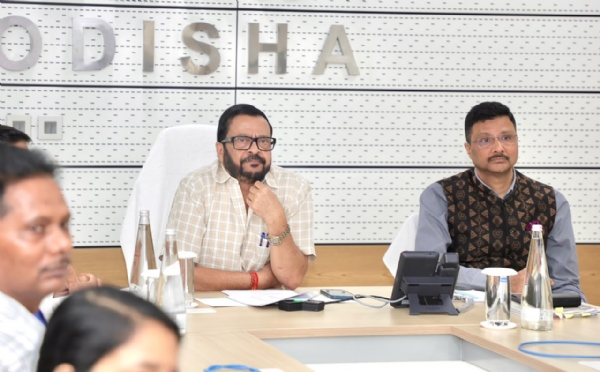
Revenue and Disaster Management Minister Suresh Pujari on Wednesday chaired a high-level review meeting at the State Emergency Operations Centre (SEOC), taking stock of preparedness measures in vulnerable districts. He interacted with the Collectors of Koraput, Gajapati, Nabarangpur, Malkangiri, Ganjam, Khordha, Rayagada, Nayagarh, Kalahandi and Kandhamal, among others.
The Minister directed the administration to give top priority to the protection of life and property and ensure timely dissemination of warnings, preparedness and swift response to any emerging situation.
“Protection of the lives and property of the people is the priority of the state government. The administration is fully prepared to deal with the situation,” Pujari said.
According to the India Meteorological Department (IMD), the deep depression over the west-central and adjoining northwest Bay of Bengal moved westwards at a speed of about 12 kmph during the past six hours.
As of 5.30 am on September 23, the system was located near latitude 18.0°N and longitude 84.7°E, approximately 70 km east-southeast of Kalingapatnam, 150 km south of Gopalpur, 230 km south-southwest of Puri and 150 km east-northeast of Visakhapatnam.
The weather system is expected to move west-northwestwards and cross the north Andhra Pradesh–south Odisha coast between Visakhapatnam and Gopalpur, near Kalingapatnam, by the night of September 23. The system is likely to cross the coast as a deep depression.
Under its influence, several districts of Odisha are likely to experience heavy to extremely heavy rainfall.
The IMD has issued a red warning for Kalahandi, Nabarangpur, Koraput and Malkangiri for the period from 8.30 am on September 23 to 8.30 am on September 24.
An orange warning has been issued for Nuapada, Balangir, Kandhamal, Rayagada, Gajapati and Ganjam during the same period.
Odisha recorded an average rainfall of 37.9 mm during the 24 hours ending at 8.30 am on Wednesday. Koraput recorded the highest district average at 93.3 mm, followed by Gajapati with 79.2 mm, Balasore with 61.8 mm, Nabarangpur with 59.6 mm and Ganjam with 55.5 mm.
At the station level, Similiguda in Koraput recorded 230.2 mm of rainfall. Other locations that received more than 100 mm included Jeypore in Koraput with 161.6 mm, Gunupur in Rayagada with 160 mm, Mohana in Gajapati with 145 mm, Borigumma in Koraput with 138.2 mm and Tentulikhunti in Nabarangpur with 138 mm.
The state government has deployed 33 Odisha Disaster Rapid Action Force (ODRAF) teams in different districts to deal with any emergency arising from heavy rainfall and flooding.
Six teams have been deployed in Ganjam, three each in Gajapati, Malkangiri and Rayagada, six in Koraput, two in Kalahandi and one in Balangir. In addition, nine ODRAF teams based at the Chhatrapur unit in Ganjam have been kept in reserve for emergency deployment.
The government has also kept NDRF and Fire Services personnel on alert, along with rescue boats, life jackets and power boats.
The sea is expected to remain rough to very rough along the Odisha coast as the weather system moves towards the coast.
The IMD has forecast squally winds of 55–65 kmph, gusting up to 75 kmph, over the west-central and adjoining northwest Bay of Bengal during September 23 and 24.
Local warning signal No. 3 has been hoisted at all ports in Odisha in view of the anticipated deterioration in sea conditions.
Fishing activities have been prohibited in the central and northern Bay of Bengal and adjoining coastal waters of Odisha and north Andhra Pradesh until September 24. District administrations have been instructed to ensure strict compliance with the restriction.
The state government has identified several potential risks associated with the heavy rainfall, including waterlogging in urban and low-lying areas, rising water levels in rivers, streams and drainage channels, flash floods in vulnerable hilly areas and landslides and mudslides in the mountainous districts of southern Odisha.
The rainfall may also affect kutcha houses, standing crops and horticultural crops. Uprooting of trees could disrupt electricity and telecommunications infrastructure in affected areas.
Ganjam, Gajapati, Rayagada, Koraput, Malkangiri, Nabarangpur and Kalahandi have been accorded the highest priority for preparedness and response. Nuapada, Balangir, Kandhamal, Puri, Khordha and Nayagarh have also been placed under heightened preparedness.
District and block Emergency Operations Centres have been instructed to remain operational round the clock. Authorities have been directed to identify vulnerable settlements, keep shelters ready and stock essential supplies, including dry food, infant food and drinking water.
The Water Resources Department is continuously monitoring river and reservoir levels and inspecting vulnerable embankment locations. Arrangements have also been made for controlled discharge of water wherever necessary.
In urban areas, authorities are monitoring drainage systems and keeping dewatering pumps ready at vulnerable underpasses. Traffic diversions will be implemented wherever required.
The Health, Drinking Water, Energy, Telecommunications, Roads and Buildings, Agriculture and Fisheries and Animal Resources departments have also been directed to remain prepared for any emergency.
The state government has advised people to closely follow local weather alerts and instructions issued by the administration. Residents in areas vulnerable to waterlogging, flash floods and landslides have been urged to exercise particular caution.
Real-time monitoring is being undertaken at both state and district levels, with authorities keeping a close watch on rainfall, waterlogging, availability of shelters, electricity and drinking water supply, deployment of rescue teams and reservoir conditions.
The review meeting was attended by Additional Chief Secretary of the Revenue and Disaster Management Department Dr Aravind Kumar Padhee, Principal Secretary of the Water Resources Department Shubha Sharma, Special Relief Commissioner Rajesh Prabhakar Patil, IMD Regional Director Dr Manorama Mohanty, Inspector General of Fire Services Uma Shankar Das, Engineer-in-Chief of the Water Resources Department Dilip Raut and other senior officials.
Collectors and district-level officials of the affected and vulnerable districts joined the meeting virtually.
---------------
Hindusthan Samachar / Monalisa Panda

18 Aug 2026
ED raids KPSC office, 20 other locations over Karnatak veterinary recruitment scam
ED raids KPSC office, 20 other locations over Karnatak veterinary recruitment scam..