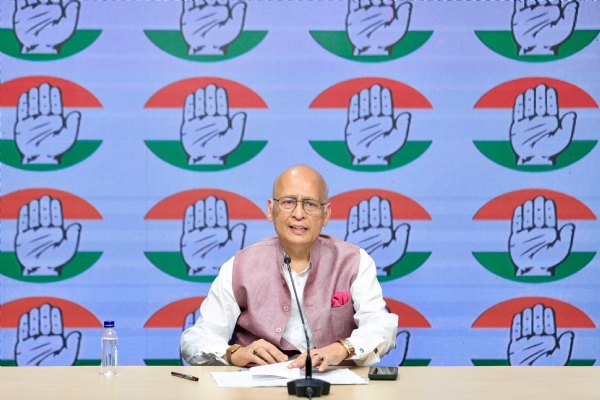
New Delhi, 23 September (H.S.): Congress Rajya Sabha MP Abhishek Manu Singhvi on Wednesday questioned the functioning of the Election Commission of India, asserting that the Chief Election Commissioner (CEC) and the other Election Commissioners have equal powers and that the CEC cannot take decisions independently.
Singhvi’s remarks came after a report claimed that Election Commissioners Sukhbir Singh Sandhu and Vivek Joshi had recorded written objections on at least 14 occasions over the past 10 months on matters linked to electoral rolls and the Special Intensive Revision (SIR) process.
Addressing a press conference at the Congress headquarters, Singhvi said the Supreme Court had made it clear nearly three decades ago that the Election Commission is a multi-member constitutional body and that every Election Commissioner has the right to participate in its decision-making process.
Referring to a 1995 Supreme Court judgment, Singhvi said the CEC should be regarded as “first among equals” rather than as an authority who can unilaterally determine matters. He argued that treating the CEC’s view as final would reduce the other Election Commissioners to a merely formal or inactive role.
According to Singhvi, the reported objections by Sandhu and Joshi covered issues including voter registration, electoral rolls, changes to Form 6 and access to the electoral database. He claimed that in August, Sandhu had described changes made to Form 6 as “unauthorised” and “illegal”, while Joshi had also raised objections to the changes.
Singhvi further said that in May, both Election Commissioners had raised concerns over the inability of Electoral Registration Officers (EROs) to access the ERO-Net portal. He also referred to an objection reportedly raised by Sandhu in August over the manner in which the Election Commission authorised an appeal in a matter concerning West Bengal.
The Congress leader said the objections relating to Form 6 should be made public, arguing that changes to the statutory form could have implications for the registration of new voters. He maintained that any alteration to the form must follow the procedure prescribed under the applicable rules.
On West Bengal, Singhvi referred to the SIR exercise and said around 38 lakh cases had emerged, with approximately 23 lakh subsequently going into appeal. He claimed that about 90 per cent of those appeals were successful and that the Election Commission had filed around 16 lakh appeals.
The controversy follows a report published on Wednesday which said Sandhu and Joshi had formally recorded objections at least 14 times during the previous 10 months. The reported concerns included changes to Form 6, access and control of ERO-Net and the electoral database, the addition and deletion of voter names, and appeals related to the SIR process in West Bengal.
The Election Commission, however, has rejected suggestions of an internal rift. The poll panel has said that differences of opinion and technical suggestions during internal deliberations are a normal part of the decision-making process. According to the Commission, all policy and administrative decisions, including those related to the SIR exercise, have been taken unanimously by the full Commission.
---------------
Hindusthan Samachar / Jun Sarkar
18 Aug 2026