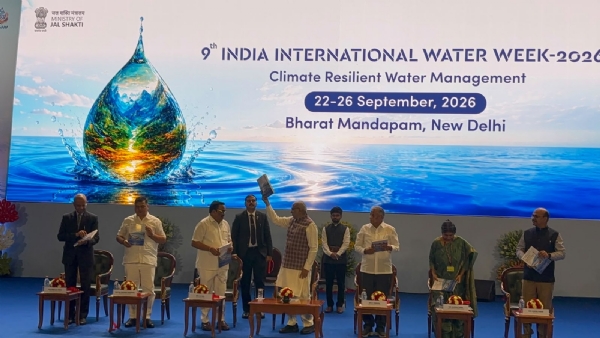
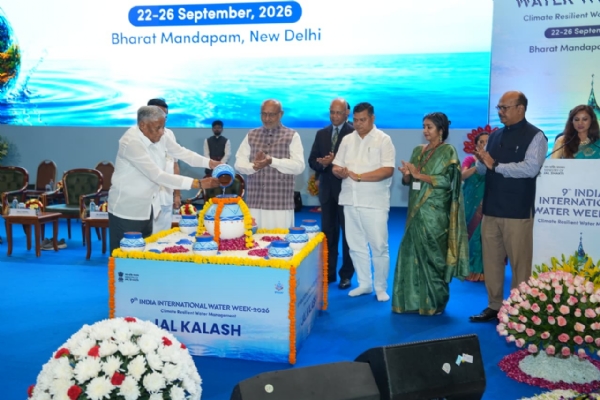
New Delhi, 22 September (H.S.): Vice President C.P. Radhakrishnan on Tuesday said water security is essential for ensuring both human and national security, stressing the need to transform water conservation into a people's movement through greater public participation.
Addressing the inaugural session of the 9th India International Water Week-2026 (IIWW-2026) at Bharat Mandapam, Radhakrishnan said water is the foundation of life and civilisation. He emphasised the need for its judicious use, conservation and effective management. The five-day event is being held from September 22 to 26.
Union Minister for Jal Shakti C.R. Patil, Ministers of State for Jal Shakti V. Somanna and Raj Bhushan Choudhary, Secretary of the Department of Water Resources, River Development and Ganga Rejuvenation Archana Verma, Secretary of the Department of Drinking Water and Sanitation Ashok K.K. Meena, Chairman of the Central Water Commission Anupam Prasad, along with representatives and experts from India and abroad, attended the event. This year's theme is Climate-Resilient Water Management.
Recalling his childhood experiences in Tamil Nadu, Radhakrishnan said he had personally witnessed water scarcity and understood the importance of ensuring access to drinking water. He said conserving water was of paramount importance for humanity and the entire world.
He said that more than two decades ago, he had undertaken a nearly 19,000-kilometre rath yatra in Tamil Nadu, one of the objectives of which was to raise awareness about river interlinking, water conservation and the proper management of water resources. He said the concept of interlinking rivers could help address situations in which one region faces floods while another suffers from drought.
The Vice President said India accounts for around 2.4 per cent of the world's land area and nearly 18 per cent of its population, while its share of global freshwater resources is approximately 4 per cent. Against this backdrop, he said India's water requirements could not be compared with those of countries where water availability is higher and population levels are lower.
Radhakrishnan described cooperation among states as crucial in resolving issues related to water sharing. He said water-related disputes and challenges could be addressed only through cooperation. Referring to the leadership of Prime Minister Narendra Modi, he said 10 memoranda of understanding had so far been signed to promote inter-state cooperation on water sharing. He cited the multipurpose Kishau Project involving six states as an important example of inter-state cooperation.
According to the Ministry of Jal Shakti, the Netherlands and Germany are participating in the international event as partner countries. Fourteen states from across the country are also taking part, while six Union ministries and departments have been invited as partners. A four-day international exhibition is being held until September 25, showcasing advanced technologies and solutions related to sustainable and climate-resilient water management. The Department of Drinking Water and Sanitation is also organising the 2nd International WASH Conference-2026 from September 22 to 24.
On the occasion, the Vice President also launched the Sustainable Urban River Management (SURM) Framework and a technical document on an Artificial Intelligence (AI) and Machine Learning (ML)-based Integrated Reservoir Sediment Management system. The SURM Framework takes into account river-basin connectivity, climate resilience, biodiversity, inclusive governance, the circular economy and sustainable economies dependent on rivers.
The AI- and ML-based Integrated Reservoir Sediment Management system will help assess sediment accumulation in reservoirs, estimate future reductions in storage capacity and identify measures for effective sediment management.
Jal Shakti Minister C.R. Patil said water is a shared resource and, therefore, water security is also a shared responsibility. Water does not remain confined within boundaries. Rivers flow from one region to another, groundwater connects multiple communities, and excess or deficient rainfall can cause floods or droughts in distant areas. Therefore, he said, water management must be approached holistically rather than in isolated segments.
Patil said India had gained significant experience in water management on a large scale and now sought not only to share these experiences with the world but also to learn from the experiences of other countries. He cited the Jal Jeevan Mission as an important example. He said that in 2019, around 3.24 crore rural households had access to tap water, while the number had now risen to approximately 16 crore households.
He said initiatives such as Jal Sanchay Jan Bhagidari and Catch the Rain had linked water conservation with public participation. As of May 31 this year, more than 1.5 crore structures related to water conservation and groundwater recharge had been created. He said that restoring a river and keeping it healthy and vibrant required an integrated approach encompassing sewage management, pollution control, biodiversity, local communities and the entire river basin. Since water-related challenges are interconnected, their solutions must also be comprehensive.
Secretary of the Department of Water Resources, River Development and Ganga Rejuvenation Archana Verma said water management in India was fundamentally a collaborative effort and that the active participation of states was essential to translate policies, technologies and innovations into tangible results on the ground. She said India International Water Week had evolved into an important multidisciplinary global platform offering opportunities for dialogue, knowledge exchange, technological demonstrations and partnerships in the water sector.
She said this year's theme, Climate-Resilient Water Management, was particularly relevant in the present context. The most visible impacts of climate change are manifested through water. Changing rainfall patterns, the increasing frequency and intensity of floods and droughts, pressure on groundwater, changes in glaciers and growing uncertainty over water availability have intensified the challenges of water management.
Verma said climate resilience required the integration of climate considerations into the planning, financing, development, operation and management of water resources and infrastructure.
She said IIWW-2026 featured a range of high-level and technical sessions organised under seven sub-themes. The international exhibition was showcasing new technologies and practical solutions for climate-resilient water management. The second International WASH Conference would further strengthen discussions on drinking water, sanitation, hygiene behaviour and climate resilience. She also emphasised the importance of participation by young professionals, researchers, start-ups and innovators.
Secretary of the Department of Drinking Water and Sanitation Ashok K.K. Meena said climate change was a global phenomenon, but its impact was felt at the local level, with water being the most visible medium through which its effects were experienced. Droughts, floods, declining groundwater levels and increasing pressure on water sources directly affect communities that depend on these resources for their daily needs.
Referring to the 2024 report of the Global Commission on the Economics of Water, titled The Economics of Water: Valuing the Hydrological Cycle as a Global Common Good, Meena said there was a need to recognise and manage the water cycle as a global common resource. He said the natural water cycle was nature's most successful water-management system. Rainwater replenishes rivers, lakes and aquifers, is used by communities and ecosystems, and eventually returns to the natural cycle.
Meena said the challenge was to determine whether water systems could be designed and managed in a manner that worked in harmony with the natural water cycle rather than disrupting it. For a long time, water had been extracted, transported from one place to another, used and then discarded. He said closing this cycle was essential for a climate-resilient future. The closer water management remains to natural systems, the more sustainable and resilient it is likely to be.
He said the government was investing not only in infrastructure but also in strengthening local capacities. Protocols for climate-resilient sanitation infrastructure had been developed in collaboration with UNICEF, incorporating greywater management as an important climate-adaptation strategy. He said every drop of water should complete its cycle locally through treatment, reuse and recharge. The more the water cycle is completed at the local level, the lower the carbon footprint and the more resilient the community will become.
It may be recalled that India's international water event was conceived in 2012 as a major programme under the name India Water Week. Its objective was to address global water challenges, promote sustainable development and showcase innovative solutions in the water sector. Over time, the event has evolved into a major global platform bringing together policymakers, researchers, industry leaders and communities from across the world.
Eight editions of India Water Week have been held since 2012, in 2012, 2013, 2015, 2016, 2017, 2019, 2022 and 2024. The event is now being organised under the name India International Water Week.
---------------
Hindusthan Samachar / Jun Sarkar
18 Aug 2026