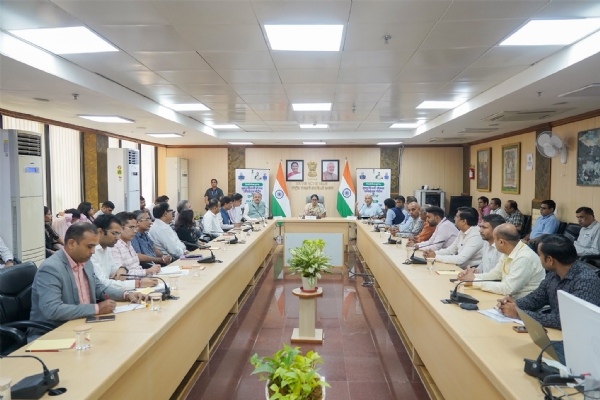
New Delhi, 21 September (H.S.): Delhi Chief Minister Rekha Gupta on Monday launched the registration portal for the ‘PM Surya Ghar–Muft Bijli Yojana’, enabling eligible residents of the national capital to register for the rooftop solar scheme. The initiative will be implemented on a first-come, first-served basis. Delhi Energy Minister Ashish Sood was also present on the occasion.
Addressing reporters at the Delhi Secretariat, Gupta said the PM Surya Ghar–Muft Bijli Yojana would mark a significant step towards expanding clean-energy generation in Delhi. She described the initiative as an important achievement of the “double-engine” government led by Prime Minister Narendra Modi, saying it would directly benefit the people of the national capital.
Gupta contrasted the initiative with what she described as the “politics of freebies” pursued by previous governments, saying the present administration was focused on the “politics of development”.
Energy Minister Ashish Sood said the government had not only continued the existing free electricity scheme but had also opened an avenue for Delhi residents to install rooftop solar systems and benefit from electricity savings for up to 25 years, while potentially earning between Rs 293 and Rs 2,400 from surplus power generation. He described the technology-driven initiative as creating opportunities for both free electricity and additional income.
Under the scheme, eligible domestic consumers with average monthly electricity consumption of up to 400 units will be provided rooftop solar systems of up to 3 kW without any upfront cost, subject to technical feasibility for installation. The Central Government will provide a subsidy of Rs 78,000, while the Delhi Government will provide an equal capital subsidy of Rs 78,000.
The Delhi Government will also cover, through an additional top-up, any gap between the available subsidies and the cost of the solar plant determined through the tendering process. Under the revised arrangement, consumers will not have to bear the installation cost upfront and wait for incentives to be received in subsequent years.
The designated solar vendor will be required to operate and maintain the installed system for five years. Thereafter, consumers will have the option of continuing maintenance through their respective electricity distribution companies (DISCOMs) for the remaining lifetime of the system, which is estimated at 25 years.
Eligible consumers will also benefit from net metering through their DISCOMs. In addition to the applicable electricity subsidy, households will be able to benefit from savings generated by their rooftop solar systems. A 3-kW system can generate around 300 units of electricity per month. A household consuming 200 units could export surplus electricity to the grid and receive payment based on the DISCOM’s average power purchase cost.
The initiative is designed to enable consumers not only to use subsidised or free electricity but also to participate in power generation by feeding surplus solar energy into the grid.
The Delhi Government has set a target of installing rooftop solar systems on 2.30 lakh homes by March 2027. It has also set a target under the Delhi Solar Policy of adding 500 MW of additional rooftop solar capacity by March 2027.
---------------
Hindusthan Samachar / Jun Sarkar

18 Aug 2026
ED raids KPSC office, 20 other locations over Karnatak veterinary recruitment scam
ED raids KPSC office, 20 other locations over Karnatak veterinary recruitment scam..