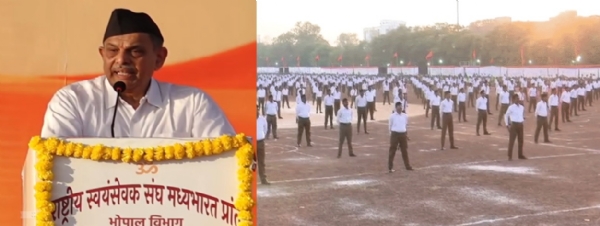
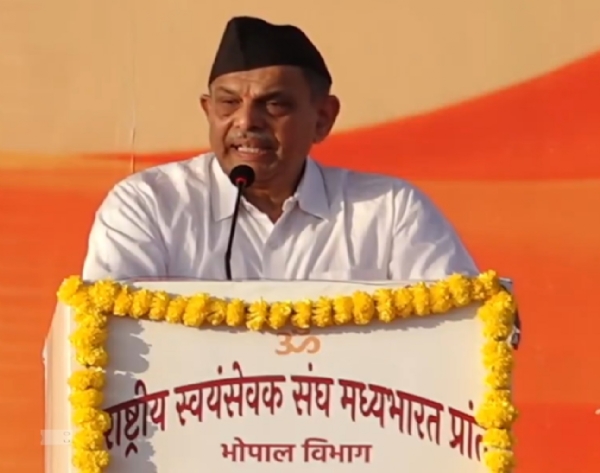
Dattatreya Hosabale addresses massive RSS volunteers’ gathering at Lal Parade Ground in Bhopal, urges society to recognise its strength and fulfil its responsibilities from the village to the nation
Bhopal, 20 September (H.S.): Over its 5,000-year civilisational journey, India has faced countless crises and struggles. There have been invasions, social challenges, prolonged conflicts and periods of subjugation. Yet India has continued to stand with its vibrant social consciousness. What is needed now is to recognise this inherent strength and move forward as an awakened society, said Rashtriya Swayamsevak Sangh (RSS) Sarkaryawah Dattatreya Hosabale.
He was addressing volunteers at a massive RSS gathering held at the Lal Parade Ground in Bhopal, the state capital, on Sunday. He said that the active participation of society, alongside the government and administration, was essential for the country's progress. Every citizen, from villages, settlements and neighbourhoods to the nation as a whole, should understand their responsibilities and contribute towards finding solutions to the challenges facing society.
The event, organised as part of the RSS centenary year celebrations, saw thousands of volunteers from five districts under the Bhopal division participate. The programme included physical demonstrations, the RSS song and musical performances by the organisation's band. The gathering presented to society the extensive network of regular RSS shakhas operating across the Bhopal division. It also conveyed the message of the organisation's social initiatives and its commitments for the coming period.
India’s greatest strength lies in its vibrant social consciousness
Hosabale said India should not be understood merely as a geographical territory or a system of governance. India is a living civilisation and society that has witnessed numerous ups and downs over thousands of years. Despite conflicts and invasions, Indian society maintained its cultural continuity.
He said that, over the long course of history, certain social evils emerged within society. Mutual hostility and divisions increased, while society gradually began to forget its own strength and identity. At such times, society must remember its national consciousness, social responsibilities and inner strength.
Referring to the episode of Lord Hanuman, the Sarkaryawah said that when the challenge of crossing the ocean arose, Hanuman had forgotten his own strength. Jambavan reminded him of his capabilities. In the same way, there is a need to awaken the strength that already exists within society. Dr Keshav Baliram Hedgewar, he said, had attempted to awaken this very social strength when he founded the RSS.
“Problems arising before any society are natural. The real question is how much capacity a society possesses to face them in times of crisis. Many of the world's ancient civilisations are today confined to history and museums, whereas India continues to exist as a living society. India's journey has witnessed invasions, conflicts, social weakening and internal divisions. Despite these circumstances, society has kept its cultural consciousness alive. This is India's distinctive characteristic. Society must understand its inner strength and capabilities and move forward,” he said.
Nation-building must begin in villages and neighbourhoods
The Sarkaryawah said work for the country should begin from villages, settlements and neighbourhoods. Problems in any area can be addressed more effectively through the active participation of the people who live there.
Referring to the ideas of Mahamana Madan Mohan Malaviya, he stressed the need to strengthen traditions of community meetings, dialogue, education, physical exercise and cultural activities in villages.
“People in every village and settlement should reflect on the needs of their own area. Sources of cultural values such as the Ramayana, the Mahabharata, the teachings of saints and the guidance of spiritual teachers should be discussed in social life so that the younger generation becomes familiar with its cultural values and social responsibilities,” he said.
Assam floods demonstrate the importance of social participation
Hosabale cited the floods in Assam as an example of growing public participation in relief and service activities. He said volunteers of Sewa Bharati had reached the affected areas to assist with relief efforts. Young people, college students and members of different sections of society also came forward to help those affected.
“During a crisis, the scope of service must be broad. Every section of society can contribute according to its capacity during disasters and difficult circumstances. During the Covid-19 pandemic too, many people from across society joined volunteers in service activities,” he said.
Behavioural change needed to end caste discrimination and untouchability
Presenting the idea of five social transformations before the gathering, Hosabale placed particular emphasis on social harmony. He said discrimination based on birth weakens the strength of society. The effort to eliminate mistreatment on the basis of caste must begin at home and through individual conduct. Referring to the episode of Lord Ram and Shabari, he underlined the need for social harmony. According to him, social change must be reflected not merely in ideas but also in everyday behaviour.
Environmental protection must go beyond speeches
Hosabale also linked environmental protection with social responsibility. “Passing resolutions on platforms will not be enough to protect nature. Responsible behaviour towards the environment must reach homes, schools, workplaces, markets, streets and neighbourhoods. Alongside planting trees, there is a need to reduce energy consumption and protect natural resources for future generations,” he said. He called for environmental protection to become an integral part of everyday life.
Patriotism is a 24-hour responsibility
Hosabale said patriotism should not be confined to any particular national day. Citizens should ask themselves every day what they can contribute to their village, neighbourhood and society. Through its shakhas, the RSS works towards character-building and social organisation. Although organising society may appear simple, he said, sustaining such work requires discipline and regularity.
He called upon people to spend an hour every day engaging with society and developing a spirit of selfless service. “Patriotism is a 24-hour responsibility,” he said.
Strength lies in organisation, progress comes through an awakened society
Hosabale said divisions based on caste, sect, language and region weaken the collective strength of society. Giving the example of organisational strength, he said individual fingers have limited strength, but their strength increases when they come together to form a fist. He called upon leaders from different sections of society to come together and view collective issues as a shared responsibility. An awakened society, he said, can play an effective role in the country's progress.
Resolve for organisational growth and character-building in the centenary year
Hosabale said the RSS's journey was a continuous process. Efforts towards character-building and social organisation would continue. He said India was advancing in several fields and that the country's achievements in science, space and other areas had increased global respect and curiosity about India.
AIIMS director: Human suffering must be the foremost consideration during a crisis
Speaking at the programme, AIIMS Bhopal Director and retired Lieutenant General Narendra Kotwal said that while providing assistance during a crisis, people should look beyond the victim's caste, language, region and religion and understand their suffering. He described this as the foundation of the spirit of service.
Referring to the Indian cultural concept of Vasudhaiva Kutumbakam, meaning the world is one family, Kotwal said that the Indian perspective of viewing the entire world as a family fosters respect for humanity. He said patriotism involves a bond with one's culture and motherland, along with a sense of respect for humanity.
Message to channel the strength of youth towards nation and society
Describing young people as one of India's greatest strengths, Kotwal emphasised health, discipline and awareness. He called upon young people to use their capabilities to address social problems. He said success should not be confined to attaining a high position. Contributing towards improving another person's life is also an important form of achievement.
He also highlighted social harmony, family and values, environmental protection, self-reliance and civic responsibility as important areas of focus. According to him, aware and responsible citizens have a significant role to play in nation-building.
Madhya Bharat Prant Sanghchalak Ashok Pandey, Vibhag Sanghchalak Somkant Umalkar and other office-bearers were present at the programme. Vibhag Karyawah Radheshyam Malviya presented a report on the RSS shakhas functioning in the Bhopal division and outlined the organisation's forthcoming action plan. Thousands of volunteers from across the Bhopal division participated in the programme.
---------------
Hindusthan Samachar / Mayank Chaturvedi

18 Aug 2026