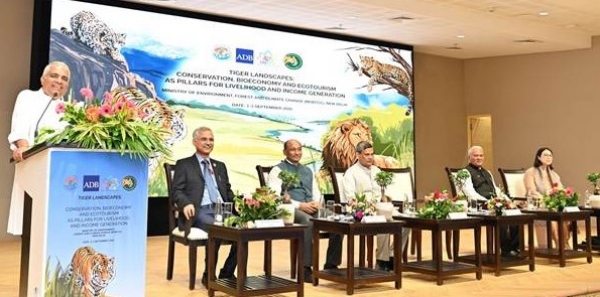
New Delhi, 02 September (H.S.): Union Minister for Environment, Forest and Climate Change Bhupender Yadav said on Wednesday that the foundation of ecological conservation must be based on conservation, harmony and human-nature coexistence. He emphasised that tiger conservation should not be limited merely to increasing tiger numbers, but should encompass the holistic protection of forests, grasslands, rivers, wildlife corridors and local communities.
Yadav made the remarks while inaugurating a two-day international workshop on “Tiger Landscapes: Conservation, Bioeconomy and Ecotourism for Livelihood and Income Generation” here. The workshop is being organised jointly by the International Big Cat Alliance (IBCA), the Asian Development Bank (ADB) and the National Tiger Conservation Authority (NTCA). The workshop is being held on September 2 and 3.
He said the survival of tigers is directly linked to healthy forests, grasslands, rivers, prey species, wildlife corridors and local communities. Tiger landscapes constitute important natural capital, making significant contributions to water security, carbon sequestration, climate regulation, biodiversity conservation and livelihoods.
He said there is now a need to move beyond species-based conservation towards integrated landscape management, which can promote socio-economic development alongside ecological security. For this, it is essential to promote nature-based solutions, innovative financial mechanisms and community-based ecotourism.
Yadav said the world is currently facing challenges such as desertification, declining soil moisture and degradation of soil quality. In such circumstances, the conservation of tiger landscapes becomes even more important. He said the traditional knowledge of local communities should be utilised to promote sustainable socio-economic development alongside nature conservation.
At the workshop, he emphasised the need to systematically document traditional knowledge and incorporate it into policies related to conservation, the bioeconomy and ecotourism. He said the IBCA should take the lead in bringing together the knowledge of local communities across the Global South and using it to formulate policies for ecological conservation.
On the occasion, a Memorandum of Understanding (MoU) was signed between the IBCA and the ADB. Under the agreement, the two institutions will cooperate in the areas of landscape conservation, sustainable development, capacity building, knowledge exchange and nature-based financial initiatives.
Yadav said that under Prime Minister Narendra Modi’s vision, the IBCA is emerging as an important platform for global cooperation among countries and institutions for the conservation of seven major big cat species.
Mia Oka, Country Director of the ADB in India, said that 2026 marks 40 years of partnership between the ADB and India. She said India is sharing its extensive experience in ecological conservation and sustainable socio-economic development with countries that are home to tigers. The ADB will support efforts to bring these countries together and create sustainable financial opportunities for ecological conservation.
Experts and government representatives from Bangladesh, Bhutan, Cambodia, Malaysia, Nepal and Vietnam, along with officials from the Ministry of Environment, Forest and Climate Change, forest departments of various states, tiger reserves, development partners, researchers and experts associated with the conservation sector, participated in the workshop. Discussions are being held on new approaches to conserving tiger landscapes while promoting sustainable development and strengthening local livelihoods.
---------------
Hindusthan Samachar / Jun Sarkar

18 Aug 2026