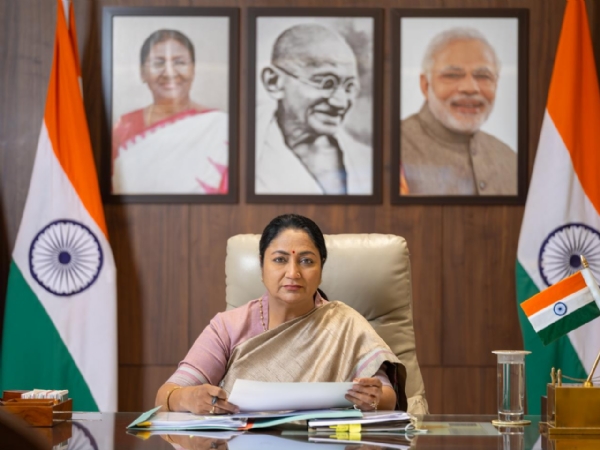
New Delhi, 02 September (H.S.): The Delhi government has taken a major step towards making the process of doing business in the national capital easier, faster, more transparent and less costly. The Delhi Cabinet, chaired by Chief Minister Rekha Gupta, has approved the Delhi Ease of Doing Business Bill, 2026. She said the Bill has been drafted as part of the second phase of the Government of India’s initiative to reduce regulatory requirements and ease the compliance burden. Following the Delhi Cabinet’s approval, the Bill will now be sent to the Ministry of Home Affairs, Government of India.
In a statement issued on Wednesday, the Chief Minister said the objective of the Bill is to transform the relationship between the government and enterprises from one based on control and suspicion to one founded on trust and facilitation. Once the proposed legislation comes into force, trust and ease of doing business will be given priority in interactions between the government and enterprises. She said the most significant provision of the proposed legislation would be a single-window system. Under this system, a simple, user-friendly online platform will be created where businesses can apply for various business-related approvals, registrations, no-objection certificates, consents and licences. The system will also cover services such as building plans, fire safety approvals, and water, sewerage and electricity connections. This will eliminate the need for citizens and businesses to visit different government offices and submit separate applications for different services. The Delhi State Industrial and Infrastructure Development Corporation (DSIIDC) will be designated as the single nodal agency for all business approvals obtained through the single-window system.
The Chief Minister said that for several activities included in Schedule 3 of the Bill, provisions would be made for approvals, permissions, licences or no-objection certificates to be granted immediately upon submission of applications. Self-declarations will be accepted for specified low-risk categories and activities falling within prescribed limits. This will provide relief from lengthy approval procedures for low-risk activities. For activities not covered under Schedule 3, approvals, permissions, licences and no-objection certificates will be granted within the timelines prescribed under the Right to Timely Delivery of Services to Citizens Act, 2026. The Bill also proposes a provision under which approval would be deemed to have been granted by operation of law upon expiry of the prescribed timeline.
The Chief Minister said the burden of repetitive registrations on businesses would also be reduced. Enterprises already registered under the Goods and Services Tax, the Food Safety and Standards Authority of India, the Micro, Small and Medium Enterprises Development Act or the labour codes would not be required to obtain separate registrations relating to trade, health-trade, eating establishments, or shops and establishments. The proposed legislation also seeks to make the inspection system trust-based. No routine inspection would be conducted for three years after an enterprise is registered. However, an inspection could be carried out if a complaint of a serious nature is received.
The Chief Minister said a negative-list-based system would be adopted to enhance the freedom to conduct business. Under this framework, an enterprise would be permitted to undertake any activity at any location, provided the activity is not included in the negative list specified in Schedule 2 of the Bill. The underlying principle would be that anything not prohibited is permitted. This would mark a shift from the existing system in which activities that are not explicitly permitted are treated as prohibited. The problem of government departments repeatedly seeking the same documents or information would also be eliminated. If a document or piece of information is already available with any authority of the Delhi government, it cannot be sought again from the applicant. In other words, the system would be based on the principle that applicants need to provide their information to the government only once.
The Chief Minister said that through all these reforms, the numerous fragmented, interconnected, discretionary and time-consuming procedures associated with doing business in Delhi would be transformed into an integrated, transparent, time-bound and technology-driven system.
---------------
Hindusthan Samachar / Jun Sarkar

18 Aug 2026
ED raids KPSC office, 20 other locations over Karnatak veterinary recruitment scam
ED raids KPSC office, 20 other locations over Karnatak veterinary recruitment scam..