New Delhi, 19 September (H.S.):
Prime Minister Narendra Modi said on Saturday that India is addressing climate challenges by integrating its ancient environmental wisdom with a modern outlook. He said India’s development is both rapid and sustainable, adding that the country’s efforts in environmental protection are not merely indicators of its development but also measures of its contribution to the future of humanity.
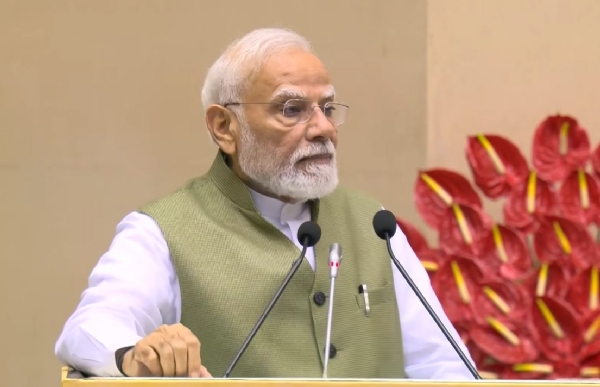
The Prime Minister made the remarks while addressing the international conference, ‘The Future of Environment and Climate Dynamics’, organised by the National Green Tribunal (NGT) at Vigyan Bhavan. Modi said India had guided the world on matters concerning nature and the environment for centuries. Drawing upon its traditions and cultural experiences, India is developing solutions to contemporary climate challenges and calling for collective global efforts. He congratulated the NGT officials and all those associated with organising the conference.
He said that the responsibility for carbon emissions has often been incorrectly placed on developing countries. The historical reality, he noted, is that India’s per capita carbon emissions remain less than half the global average even today. Per capita carbon emissions in developed countries are around six times higher than those of India. Modi said India consistently presents this fact forcefully on global platforms.
Modi said India is setting new benchmarks for environmental protection while taking the world along with it. Initiatives and platforms such as ‘One Sun, One World, One Grid’, the International Solar Alliance, the Coalition for Disaster Resilient Infrastructure (CDRI), the Global Biofuels Alliance, the International Big Cat Alliance and Mission LiFE are advancing India’s commitment to climate and environmental protection.
He said India has made remarkable progress across every environment-related sector over the past 12 years. The country’s solar power capacity, which stood at around two gigawatts 12 years ago, has now crossed 160 gigawatts. Under the PM Surya Ghar: Muft Bijli Yojana, rooftop solar panels have been installed in more than five million households. Under the PM-KUSUM scheme, solar pumps have been installed on the farms of around three million farmers. The Prime Minister said solar power alone had helped prevent approximately 200 million tonnes of carbon emissions.
The Prime Minister said that India’s wind power capacity had tripled over the past 12 years, while hydropower capacity had also increased. The country’s non-fossil fuel energy capacity has grown nearly fourfold. India is promoting technologies such as coal gasification for cleaner utilisation of coal and is also accelerating work in the nuclear energy sector.
Modi said India is also advancing rapidly in clean transportation and green hydrogen. The country’s first hydrogen-powered train has commenced operations. Over the past 12 years, sales of electric vehicles have increased by around 950 times. Before 2014, fewer than 3,000 electric vehicles were sold in a year, whereas approximately 2.5 million electric vehicles were sold last year.
He said that by 2014, around 250 kilometres of metro network was operational in five cities, whereas today metro services are available in more than 20 cities and the country’s metro network has exceeded 1,000 kilometres. Nearly 100 per cent electrification of the railway network has helped save the consumption of crores of litres of diesel. Freight trains operating on the approximately 3,000-kilometre dedicated freight corridor are carrying loads equivalent to hundreds of trucks in a single trip. Transportation has also commenced along nearly 5,000 kilometres of waterways.
Highlighting the work undertaken in the area of water conservation, the Prime Minister said that more than 70,000 Amrit Sarovars had been created across the country. Under the ‘Catch the Rain’ campaign, around 15 million water-harvesting structures have been developed. Through the Pradhan Mantri Krishi Sinchayee Yojana, more than 20 million farmers have been connected with modern irrigation facilities. The ‘Per Drop More Crop’ initiative is helping conserve water.
He said that Shree Anna, or millets, are crops that require relatively less water. Millet production and exports have increased in India, with exports reaching around 150,000 tonnes. India’s efforts also contributed to 2023 being observed as the International Year of Millets.
Modi said natural farming is also being promoted. As many as 24,000 natural farming clusters have been established across the country, while around 3,000 varieties of climate-resilient crops have been developed. Over the past 12 years, very dense forest cover has increased by more than 22 per cent. Under the ‘Ek Ped Maa Ke Naam’ campaign, crores of trees have been planted.
He said India has banned single-use plastic and is promoting a circular economy based on the principles of reducing consumption, reusing materials and recycling waste. Through the Gobardhan scheme, cow dung and other organic waste in villages are being converted into useful resources.
The Prime Minister said that in India’s cultural ethos, the Earth is regarded as a mother. Guided by this sentiment, India is working towards building a responsible and sustainable future. He expressed confidence that the new ideas and solutions emerging from the discussions at the conference would provide support and direction for future generations.
Chief Justice of India Justice Suryakant, Union Minister for Environment, Forest and Climate Change Bhupender Yadav, Attorney General for India R. Venkataramani, and NGT Chairperson Justice Prakash Srivastava, among other dignitaries, were present at the event.
The two-day conference was attended by environmental experts, Supreme Court and High Court judges, district judges, secretaries of various ministries, senior officials, and judicial representatives from 17 countries.
---------------
Hindusthan Samachar / Jun Sarkar
18 Aug 2026