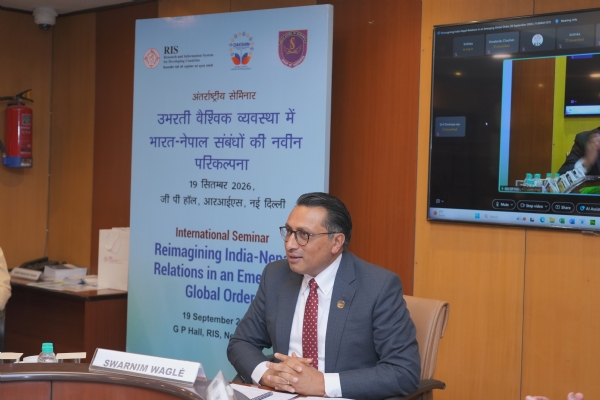
New Delhi, 19 September (H.S.): An international seminar organised by the Research and Information System for Developing Countries (RIS) emphasised taking India-Nepal relations into a new phase of connectivity, economic cooperation and shared development. On the occasion, Nepal’s Finance Minister Dr. Swarnim Wagle said the two countries had an opportunity to build a more ambitious partnership on the strong foundation of their historic and deep-rooted ties.
The Research and Information System for Developing Countries (RIS) on Saturday organised a seminar on the theme ‘Reimagining India-Nepal Relations in the Emerging Global Order’. The event was attended by Nepal’s Finance Minister Dr. Swarnim Wagle; Muni Mahawar, Additional Secretary (North) in the Ministry of External Affairs, Government of India; Prof. Ram Singh, Director of the Delhi School of Economics; former Foreign Secretary of India and former RIS Chairman Shyam Saran; Dr. Sheshadri Chari, Member of the RIS Governing Board and Governing Council; and RIS Director General Prof. Sachin Kumar Sharma, among a large number of policymakers, diplomats, economists, academics and strategic affairs experts.
The seminar held detailed discussions on the future trajectory of India-Nepal relations, trade and investment, connectivity, energy cooperation, tourism, digital and financial linkages, cross-border production networks and various aspects of shared development.
Addressing the gathering, Dr. Swarnim Wagle said India-Nepal relations were not merely those between two neighbouring countries, but were rooted in shared history and culture, deep people-to-people ties and economic cooperation. He said the two countries had an opportunity to take cross-border connectivity, energy trade, investment and regional economic integration to a new level. He emphasised that the time had come to move beyond traditional cooperation and develop new mechanisms that could deliver tangible economic benefits to citizens of both countries while presenting a model of regional development.
Muni Mahawar said India and Nepal had made significant progress in electricity trade, road and rail connectivity, petroleum pipelines and other infrastructure projects over the past few years. Building on these achievements, the two countries should move forward on major and transformative initiatives that had remained unrealised so far for various reasons. If both countries set targets commensurate with their potential, the scope of bilateral cooperation could expand far beyond its present level, he said.
Prof. Ram Singh said the greatest strength of India-Nepal relations lay in their continuity and strong social foundations. The close ties between the people of the two countries, the open border and their shared cultural heritage represented a unique example in the world. He said there was a need to make these relations more institutionalised and modern in order to promote economic development and prosperity and accelerate Nepal’s development journey.
Dr. Sheshadri Chari said India and Nepal should identify areas where tangible and practical outcomes could be achieved in a relatively short period. He said the two countries would need to move forward with a shared vision to improve living standards, expand economic opportunities and promote regional stability.
Prof. Sachin Kumar Sharma said strong complementarities existed between India and Nepal in areas including trade, energy, education, healthcare, skill development and development partnership. He said bilateral relations had moved beyond the phase of geographical proximity and should now advance towards shared prosperity. This, he said, would require reducing mutual barriers, strengthening connectivity and expanding economic opportunities.
Experts participating in the seminar also deliberated on the changing global economic and strategic landscape. Key issues discussed included geo-economic fragmentation, evolving trade and industrial policies, technological transformation, climate change, energy and food security, and emerging challenges confronting developing countries.
---------------
Hindusthan Samachar / Jun Sarkar
18 Aug 2026