New Delhi, 19 September (H.S.): Union Home and Cooperation Minister Amit Shah will inaugurate the Barapullah (Banda Singh Bahadur Setu) Phase-3 corridor on September 29. With the completion of the project, direct connectivity will be established between the All India Institute of Medical Sciences (AIIMS) and Mayur Vihar Phase-1.
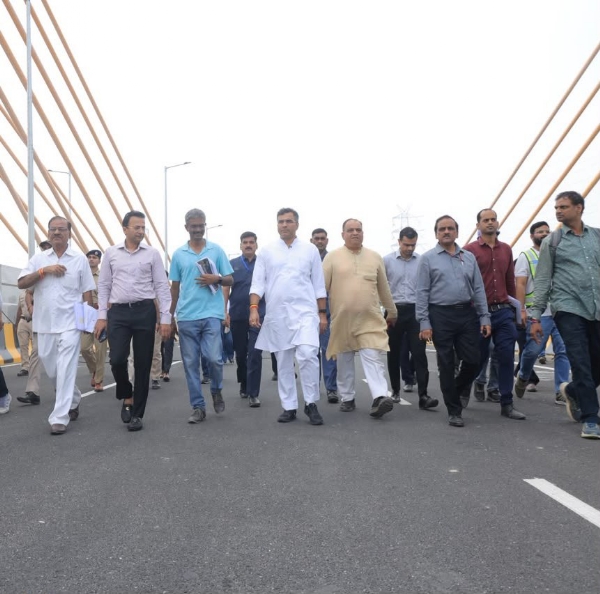
Delhi Public Works Department Minister Parvesh Sahib Singh, after inspecting the Barapullah Phase-3 project on Saturday, said Union Home Minister Amit Shah would inaugurate the corridor on September 29, bringing the long-delayed project to completion. In a post on social media platform X, he said that a project which had remained stalled for years had been completed by the BJP-led Delhi government in just one and a half years, giving a major boost to the capital’s infrastructure and connectivity.
He said that under the leadership of Chief Minister Rekha Gupta, the government was moving ahead with a particular focus on completing and delivering long-pending projects within the stipulated timelines.
The project aims to provide seamless connectivity between East and South Delhi by linking Mayur Vihar Phase-1 with AIIMS through signal-free routes. The new flyover will connect with the existing Barapullah Phase-1 flyover at Sarai Kale Khan, completing an approximately nine-kilometre-long corridor.
The Barapullah project is a multi-phase urban infrastructure initiative aimed at providing faster, signal-free connectivity between East and South Delhi. The first phase was constructed in 2010 during the Commonwealth Games, connecting Sarai Kale Khan with Jawaharlal Nehru Stadium. The second phase was extended to INA Market and Aurobindo Marg in 2018. The third phase, completed in 2026, connects Mayur Vihar with Sarai Kale Khan and AIIMS.
The approximately 3.5-kilometre-long corridor features eight ramps, a cycle track and modern design elements. The project has reduced travel time from around 35-40 minutes to approximately 15 minutes and is expected to ease congestion on the Ring Road, DND Flyway and National Highway-24. However, the project was delayed by nearly nine years due to land acquisition and administrative hurdles, with its cost eventually rising to Rs 1,635 crore.
The project derives its name from the Mughal-era Barapullah Bridge, which was constructed in the 17th century during the reign of Emperor Jahangir by Mihr Banu Agha. It was subsequently renamed Baba Banda Singh Bahadur Setu.
The Delhi government approved the renaming on June 8, 2016, at a meeting of the State Naming Authority chaired by then Deputy Chief Minister Manish Sisodia. The decision came as the 300th anniversary of Baba Banda Singh Bahadur’s martyrdom was being commemorated, amid longstanding demands to associate a major Delhi infrastructure project with his name.
As Baba Banda Singh Bahadur was martyred in the Mehrauli area of Delhi, where a gurdwara is also dedicated to him, the flyover was named after him. The renaming was intended not only to associate a major transport infrastructure project with the city’s historical heritage but also to honour Delhi’s cultural memory.
---------------
Hindusthan Samachar / Jun Sarkar
18 Aug 2026