Youth Dharma Parliament in Ujjain: Dr Bhagwat says- Abandon Ego and Bring Dharma into Practice
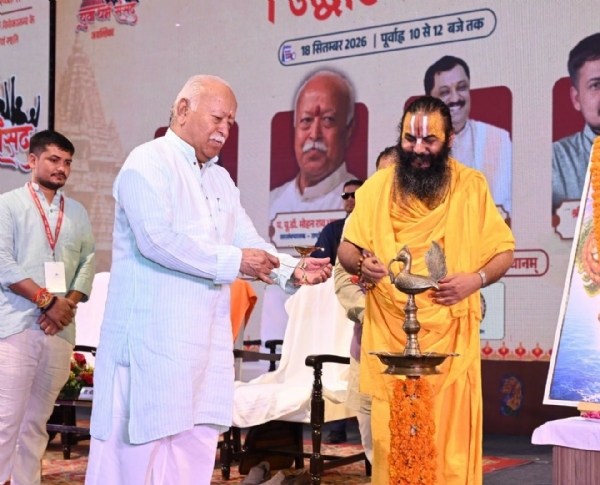
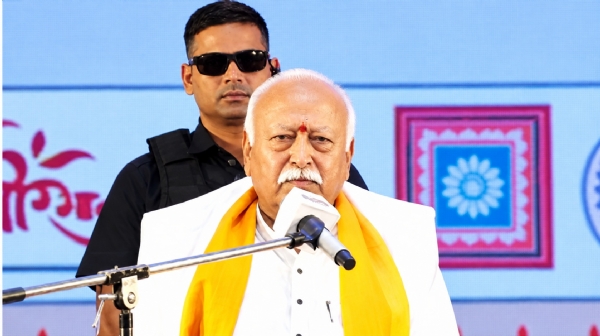
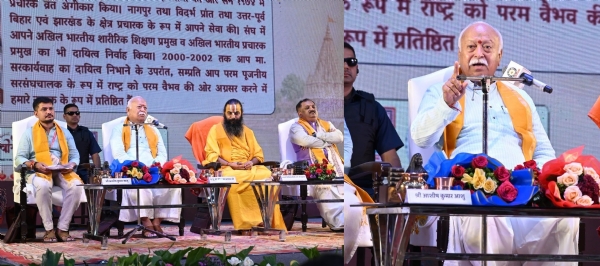
Ujjain, 18 September (H.S.). A person's greatest misconception begins the moment they, driven by ego, assume that the world will operate according to their desires and control. Nature does not bow to any individual's authority, nor do its laws change based on human will; the rising and setting of the sun serve as a simple example of this. Addressing the youth at the 'Yuva Dharma Sansad' held in Ujjain on Friday, Rashtriya Swayamsevak Sangh (RSS) Sarsanghchalak Dr. Mohan Bhagwat called upon them to look beyond the confines of mere rituals and modes of worship and instead integrate ‘Dharma’ into their daily lives and conduct.
Dr. Bhagwat stated that it is incorrect to equate ‘Dharma’ with the English word 'religion'. While 'religion' implies binding and enforcing discipline, ‘Dharma’ liberates the individual. He noted that in India, ‘Dharma’ permeates every stage of life. Whether acknowledged or not, ‘Dharma’ persists from the beginning of existence to its end, and many of life's principles operate in accordance with it.
He explained that Western society observed the practices, rituals, and discipline associated with ‘Dharma’ in India and mistook it for the 'religion' prevalent in their own cultures; subsequently, the same term came to be used for ‘Dharma’ in India as well. Bhagwat clarified that while rituals are a part of practicing ‘Dharma’, rituals alone do not constitute the entirety of ‘Dharma’.
Do not let ego convince you that everything is under your control
During the event, RSS Sarsanghchalak Dr. Bhagwat identified human ego as one of the greatest obstacles to understanding ‘Dharma’. He remarked that when a person begins to believe that everything is under their control and that events must unfold according to their wishes, they start to drift away from reality. He illustrated this point with examples. He also dismissed the notion that the ‘Bhagavad Gita’ and the ‘Ramayana’ are texts meant to be read only after retirement.
He emphasized that ‘Dharma’ endures from the inception of existence to its conclusion; therefore, understanding ‘Dharma’ and embodying it in one's life during youth is equally crucial. He urged the youth to lead lives that inspire the entire world. According to him, ‘Dharma’ cannot be confined to any specific age, mode of worship, or religious activity.
Refraining from littering and obeying traffic rules is also ‘Dharma’
Explaining the practical aspect of ‘Dharma’, Bhagwat stated that the act of not littering after a meal constitutes ‘Dharma’. Adhering to traffic rules on the road is also ‘Dharma’. In essence, ‘Dharma’ should be reflected in a person's daily conduct. He emphasized that one must respect one's own method of worship, whether derived from nature, a guru, or tradition, while extending equal respect to the worship practices of others. Refraining from attempting to convert others to one's own beliefs is also part of practicing ‘Dharma’.
We shall live and help others live
Sarsanghchalak Bhagwat also remarked that India is a deeply spiritual nation. While India is poised to grow significantly in economic and strategic terms, this is merely a milestone, not the ultimate destination. He stated that it is inappropriate to interpret India's system as ‘secular’ in the Western sense; rather, the State's responsibility in India is to avoid discrimination and ensure respect for everyone.
Highlighting the traditions of altruism and social responsibility in India, he noted that ancestors engaged in trade and earned wealth, yet also worked for the welfare of society through acts of charity (Dharmadaya), such as the construction of ‘Dharamshalas’ in cities. His message was that one should earn a living and sustain one's life through one's own intellect, but not in a manner that causes suffering to others. Life attains true meaning only when the individual’s progress is accompanied by the advancement of society as a whole.
‘Dharma’ is rooted in truth
Bhagwat stated that ‘Dharma’ is based on truth. Diversity is an inherent part of nature and creation, and it must be accepted; alongside this, he underscored the fundamental unity of humanity. He observed that while truth can be harsh, it is precisely this truth that fosters empathy within humans for others.
He noted that India has refrained from unnecessary interference in global conflicts. Governments with diverse ideologies have held power, yet India has consistently extended help to people during times of crisis. Without naming the neighboring country to the west, he remarked that it repeatedly stirs up disputes and harasses India. Despite this, India has extended assistance during times of need without regard for that nation's ideology or the nature of its regime.
A Dharma Above Religion
Citing Gurudev Ranade, Bhagwat noted that, according to him, there is a ‘Dharma’ that stands above every ‘religion’. He explained that when distinct religions operate in accordance with ‘Dharma’, they guide humanity toward liberation; however, when they deviate from ‘Dharma’, situations involving sectarian strife and atrocities committed in the name of religion can arise.
Referring to the etymology of the word ‘religion,’ he pointed out that it relates to binding and maintaining discipline, whereas the core meaning of ‘Dharma’ is rooted in the concept of ‘sustaining’ or ‘upholding.’ He observed that the long-standing neglect of its heritage has created various mental ‘knots’ in India, psychological barriers that need to be resolved through truth and knowledge.
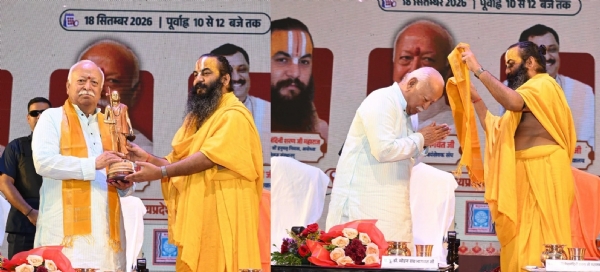
It is noteworthy that approximately 1,700 young students from across the country are participating in the ‘Yuva Dharma Sansad’ organized by the Sevagya Sansthanam at Ujjain’s Gita Bhavan from September 17 to 19. Around 300 scholars, teachers, researchers, and religious (Dharmik)leaders also took part in the event on Friday. Dr. Mohan Bhagwat attended the inaugural session, while Chief Minister Dr. Mohan Yadav is scheduled to attend the closing ceremony on September 19.
Organized under the guidance of Acharya Mithileshanandini Sharan Ji Maharaj, this event marks the sixth edition of the Yuva Dharma Sansad. Previous editions have been held in Kashi, Ayodhya, Mathura, Haridwar, and Kanchipuram. The event is proposed to be held in Dwarka next year. The program features dialogues on topics such as the existential concept of Dharma, artificial intelligence and the conflict of information and ideas, alongside special address sessions by selected youths from across the country.
---------------
Hindusthan Samachar / Mayank Chaturvedi
18 Aug 2026