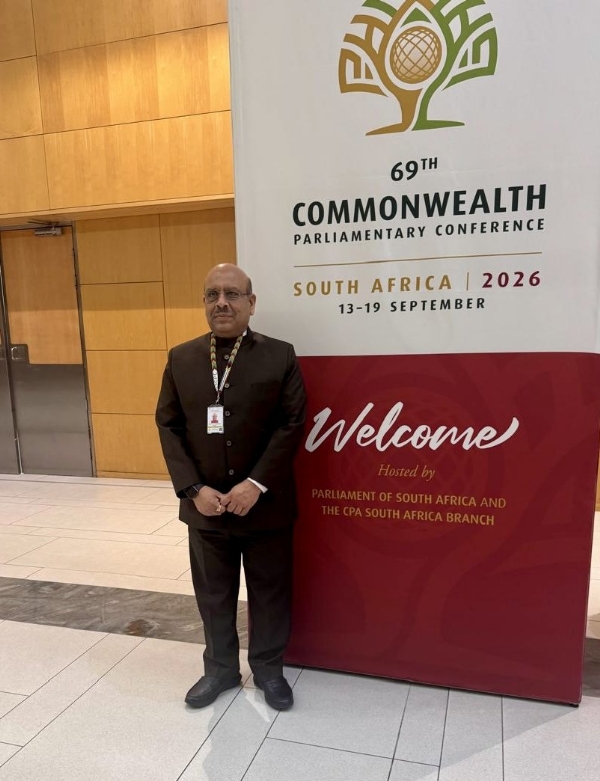
New Delhi, 17 September (H.S.): Delhi Legislative Assembly Speaker Vijender Gupta said the Commonwealth should not be assessed by the declarations it adopts, but by the institutions it strengthens and the solutions it delivers. Gupta made the remarks at the 69th Commonwealth Parliamentary Conference held in Cape Town, South Africa. He addressed a session on the theme, ‘New Leadership Opportunities for the Commonwealth: Parliamentary Action to Strengthen Democracy and International Law’. The information was provided in a statement issued on Thursday.
Speaking on issues including armed conflicts, geopolitical competition, declining trust in institutions, artificial intelligence and climate change, Gupta said parliaments must function as institutions capable of translating public concerns and international commitments into legislation, oversight and accountable action.
He said elections provide people with democratic rights, but the real strength of democracy is reflected in the period between elections. This requires legislative scrutiny, transparency in government expenditure, effective parliamentary committees and meaningful citizen participation.
The Commonwealth comprises around 56 countries and is home to nearly one-third of the world’s population. Gupta said its diversity gives the organisation an important opportunity to demonstrate how shared commitments to democracy, human rights and the rule of law can be transformed from declarations into concrete and measurable institutional change.
Referring to the international system, Gupta said international commitments do not implement themselves. Domestic legislation, budgetary cooperation and parliamentary oversight are essential for translating global obligations into action. Citing Article 51 of the Constitution of India, he said legislatures have an important role in reviewing international treaties, foreign policy and the implementation of international obligations.
He also emphasised the need to reform global institutions such as the United Nations and its Security Council and the World Trade Organization. Institutions created in the previous century, he said, should be adapted to contemporary realities while safeguarding the interests of emerging economies, smaller countries and vulnerable communities.
On the increasing use of technology in legislatures, Gupta said artificial intelligence can make research and access to information easier for people, but it also carries risks related to misinformation, manipulation and exclusion. Technology, he stressed, should remain a tool for democratic accountability, not a substitute for it.
Referring to India’s paperless legislative initiatives, the National e-Vidhan Application and multilingual technologies, Gupta also highlighted ‘Vidhan Sathi’, the AI-enabled legislative research assistant of the Delhi Legislative Assembly. He said the success of digital technology should not be measured merely by its novelty, but by the extent to which it strengthens parliamentary oversight, saves institutional resources and brings citizens closer to legislatures.
The Assembly Speaker also called for climate resilience and inclusive participation to become important components of the Commonwealth’s parliamentary agenda. He said smaller countries face greater risks because of rising sea levels, extreme weather events, debt pressures and limited institutional capacity.
Parliaments, he said, should therefore review climate-related commitments and ensure that resources available for addressing climate change reach vulnerable communities.
---------------
Hindusthan Samachar / Jun Sarkar
18 Aug 2026