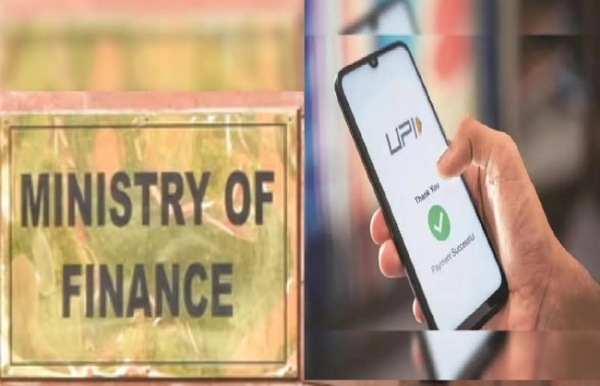
New Delhi, September 17 (H.S.): The Ministry of Finance has rejected allegations that the decision to impose a 0.4 per cent Merchant Discount Rate (MDR) on high-value UPI transactions was taken under pressure from the United States.
The ministry on Thursday also issued a clarification amid a controversy over media reports concerning the implementation of a 0.4 per cent MDR on selected person-to-merchant (P2M) UPI payments exceeding Rs. 2,000 under the recent guidelines issued by the National Payments Corporation of India (NPCI). The ministry said the latest NPCI guidelines permit only RuPay credit cards for transactions through UPI using credit cards, meaning foreign credit cards would not derive any benefit from the provision.
The Department of Financial Services (DFS), in a post on X, issued the clarification in response to observations in the 2026 report of the United States Trade Representative (USTR) alleging that American electronic payment service providers were not being given treatment equivalent to RuPay cards in India's UPI payment system. The DFS said, “NPCI's circular dated September 15 does not permit credit transactions on UPI through any credit card other than RuPay cards.” It added that the allegation that MDR was being introduced due to external influence was “incorrect and misleading.”
The Finance Ministry's clarification comes at a time when some opposition parties, including the Congress, have alleged that the Central government decided to impose a 0.4 per cent MDR on merchant UPI transactions above Rs. 2,000 under US pressure.
NPCI said the objective of introducing MDR on selected high-value UPI transactions is to create a sustainable revenue model for the UPI ecosystem. According to NPCI, this would also provide smaller third-party application providers with greater opportunities to compete and increase their market share.
Earlier, in November 2020, NPCI had set a 30 per cent market-share cap for third-party application providers. However, it has maintained that in the absence of a sustainable revenue model, companies other than the dominant players were unable to compete effectively.
Under NPCI's new guidelines, a 0.4 per cent charge will be levied from October 15 on person-to-merchant (P2M) UPI payments exceeding Rs. 2,000. The charge will be borne by the merchant and will be capped at Rs. 300 for transactions of Rs. 75,000 or more. No charge will be imposed on person-to-person transactions or on routine small-value merchant payments.
For transactions above Rs. 2,000 involving essential services such as railways, telecommunications, fuel and insurance, a charge of Rs. 5 will apply. For capital-market transactions, including mutual funds and stock broking, an MDR of 0.02 per cent will be applicable, subject to a maximum charge of Rs. 300.
It is noteworthy that small merchants collecting up to Rs. 1 lakh per month through UPI QR codes will be completely exempt from the charge. MDR will also not be applicable to UPI QR payments made to merchants in villages and small towns.
Hindusthan Samachar / Jun Sarkar