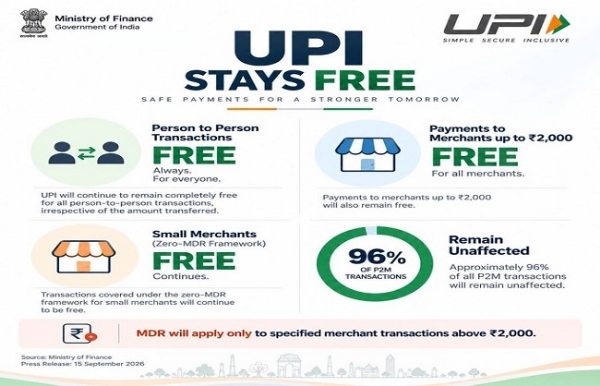
New Delhi, 16 September (H.S.): The Central Government has clarified that no charges will be levied on ordinary UPI transactions between individuals, irrespective of the amount involved. In a statement issued on Wednesday, the Ministry of Finance said transactions covered under the zero Merchant Discount Rate (MDR) framework for small merchants, as well as merchant payments of up to Rs 2,000, will also remain free.
In a post on X, the Ministry of Finance said UPI remains free for customers. Sending money to friends, making payments at shops or scanning QR codes will not attract any charges. The ministry also dismissed claims that the changes were prompted by foreign influence, stating that decisions concerning India’s UPI policy are taken independently with the objective of building a self-reliant, inclusive and affordable digital payments ecosystem.
Key features of the changes to UPI charges:
No charge on P2P transactions: According to the Ministry of Finance, person-to-person (P2P) money transfers will remain completely free, regardless of the transaction amount.
Protection for small merchants: Merchants receiving up to Rs 1 lakh per month through UPI QR-code payments will not be charged under the zero-MDR framework.
Everyday payments remain protected: The Ministry of Finance said more than 95 per cent of merchant payments are below Rs 2,000 and will continue to remain free.
Nominal MDR on transactions above Rs 2,000: Merchant transactions exceeding Rs 2,000 will attract a nominal Merchant Discount Rate of 0.4 per cent. The rate is significantly lower than charges associated with credit cards and other payment networks. The new framework will come into effect from October 15, 2026.
Charges for essential services: Transactions above Rs 2,000 involving sectors such as railways, fuel, telecommunications and bill payments will attract a fixed charge of Rs 5.
Special lower rate: Payments involving mutual funds and securities will attract a charge of 0.02 per cent, subject to a maximum of Rs 300.
Customer protection measures
Directions to banks: Banks cannot pass the merchant MDR on to customers.
No hidden charges: UPI applications cannot impose additional platform charges on customers.
Addressing the misconception of “external pressure”: The Ministry of Finance said claims that the changes were introduced because of foreign influence are incorrect. It reiterated that decisions relating to India’s UPI policy are taken independently, with the objective of creating a self-reliant, inclusive and affordable digital payments system.
Why this matters:
The Ministry of Finance said that since its launch in 2016, UPI has evolved into the world’s largest real-time interoperable payments system. The ministry said this growth has taken place on India’s own terms. In August 2026 alone, UPI processed 24.5 billion transactions. Official NPCI data show that the transactions were worth approximately Rs 29.8 lakh crore.
The nominal charge on higher-value merchant transactions is intended to help sustain the UPI ecosystem and support continued investment in infrastructure, cybersecurity and innovation.
Better infrastructure and cybersecurity
The new framework is also intended to support small merchants in Tier III to Tier VI cities and rural areas, while promoting awareness and incentives to encourage wider UPI adoption.
The framework seeks to ensure that resources generated from higher-value merchant transactions are used to support small businesses and strengthen digital payment infrastructure across the country.
---------------
Hindusthan Samachar / Jun Sarkar