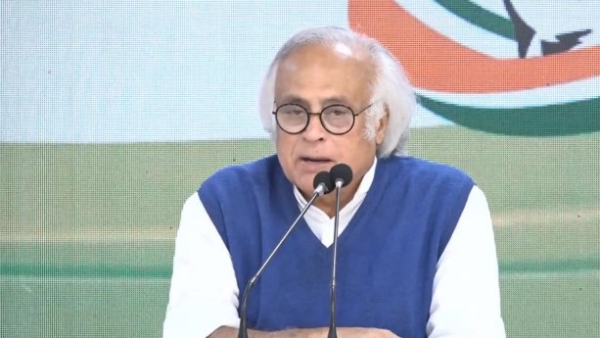
New Delhi, 16 September (H.S.): Congress General Secretary in charge of the Communications Department, Jairam Ramesh, on Wednesday criticised the central government over the threat of US tariffs, stricter immigration regulations and the decision to introduce a Merchant Discount Rate (MDR) on UPI transactions.
He said that after being passed by the US Senate, the lower house of the US Congress is now set to vote on a bill that provides for imposing import tariffs of up to 100 per cent on India. At the same time, the Trump administration is tightening restrictions on Indian IT professionals by increasing the cost of H-1B visas and introducing stringent rules for immediate deportation in the event of job loss.
In a post on the social media platform X on Wednesday, Jairam Ramesh said that the US House of Representatives is set to vote on a bill that provides for imposing import tariffs of up to 100 per cent on India. The US Senate has already approved the legislation. On the one hand, the US administration is tightening restrictions on Indian immigrants and IT professionals, increasing the cost of H-1B visas and introducing stringent rules for immediate deportation following job loss; on the other hand, the Modi government is adopting what he described as a posture of complete capitulation before Washington.
The Congress general secretary directly linked the decision to introduce a fee structure on UPI transactions to alleged US pressure. He said that earlier this year, the US Trade Representative had questioned the fact that UPI transactions were entirely free of charge and that this had kept US card companies Visa and Mastercard out of the market.
Ramesh claimed that, under this pressure, the Modi government had ended its zero-MDR policy. He asked whether the MDR had been fixed at 0.4 per cent because debit cards also attract a 0.4 per cent charge. He also questioned whether the decision had been taken to make US card companies competitive with India's UPI system.
Ramesh also rejected the government's claim that the move was necessary for the sustainability of UPI. He said that the annual cost of operating the entire UPI system is approximately Rs 20,000 crore, which is less than 10 per cent of the annual dividend transfer made by the Reserve Bank of India to the government, which, he said, is used to keep the Centre's fiscal figures in order.
---------------
Hindusthan Samachar / Jun Sarkar

18 Aug 2026