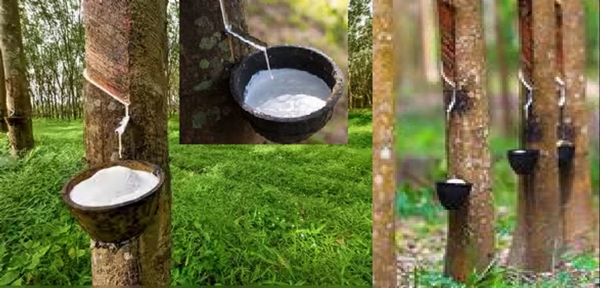
Campaign Accelerated to Bridge the Domestic Shortfall of 522,000 Tonnes; Plantation on 179,000 Hectares under INROAD; North-East’s Share Expected to Rise from 15 to 40-45 Per Cent
New Delhi, 15 September (H.S.). Amid India’s growing industrial economy, the widening gap between domestic demand and production of natural rubber has now emerged as a new challenge for self-reliance. The country has an annual demand of around 1.427 million tonnes of natural rubber, while production is approximately 905,000 tonnes. This means India has to rely on imports to meet the shortfall of around 522,000 tonnes.
It is noteworthy that natural rubber is being imported from Côte d’Ivoire, Vietnam, Thailand, Indonesia and Malaysia. In the case of synthetic rubber, dependence on South Korea and Japan continues. Against this backdrop, the country’s rubber production map is changing rapidly to bridge this gap. An increase of around 58 per cent in existing production is required to raise rubber production, and keeping this target in mind, new plantations, processing units, research, training and rubber-based industries are being expanded.
INROAD Changes the Direction
In fact, the Indian Natural Rubber Operations for Assisted Development, or INROAD, project is playing a key role in this campaign. Operated with the cooperation of the Rubber Board and the Automotive Tyre Manufacturers’ Association, the project is developing large-scale new rubber plantations in North-East India and West Bengal. According to data that has emerged in connection with the INROAD project, new rubber plantations had been established across 179,000 hectares in the country by 15 July 2026.
The figures show that this is around 94 per cent of the निर्धारित target of 190,000 hectares. These new plantations are expected to produce around 300,000 tonnes of natural rubber annually. As a result, the North-East’s share of the country’s total natural rubber production could rise from the present level of around 15 per cent to 40-45 per cent.
Production Rising from Tripura to Assam
Tripura is a major example of this transformation. Over the past decade, the state’s natural rubber production has increased from 39,000 tonnes to 91,500 tonnes. Rubber is being cultivated across more than 110,000 hectares here. In Assam, rubber plantations have been developed across around 50,000 hectares. The state’s production has increased from 13,600 tonnes to 46,500 tonnes.
₹15.5 Billion Industrial Hub
The proposed Special Economic Zone in Sabroom, Tripura, with an estimated investment of around ₹15.5 billion, is an important step towards developing rubber-based industries, processing, trade and manufacturing together. It is expected to generate around 12,000 skilled jobs. Meanwhile, rubber clones collected from Sri Lanka, Indonesia, Thailand, Malaysia, Vietnam and Côte d’Ivoire have been preserved at the International Hevea Clone Museum established in Tripura.
In fact, these are being used to develop rubber varieties that are disease-resistant, higher-yielding and suited to changing climatic conditions. Experiments are also under way in Assam on genetically modified rubber plants and new agricultural technologies. In this way, after Kerala, Tripura has become the country’s third-largest natural rubber producer.
Production in Meghalaya has also increased from 7,570 tonnes to 11,775 tonnes. Around 180,000 hectares of rubber plantations have been developed across the North-East. Meghalaya’s first centrifuged latex unit has been established at a cost of ₹188 million. This will provide more than 3,000 farmers in the Garo Hills with local processing facilities.
Employment Expansion from Cultivation to Industry
A detailed study of the data of Indian Natural Rubber Operations for Assisted Development (INROAD) has also revealed that, in view of the need for trained human resources to expand the rubber sector, a nodal centre of the National Rubber Training Institute has been established in Nagaland. More than 400,000 hectares of land in the state is considered suitable for rubber cultivation, while around 20,000 hectares has so far been developed. Through three nodal training centres in the North-East, the target is to train more than 10,700 people through 712 training programmes. Skills related to cultivation, processing, product manufacturing and quality control are being developed.
Preparing for the Global Market
Along with increasing production, Indian Natural Rubber Operations for Assisted Development is also focusing on the quality and sustainable production of Indian rubber. Through the Indian Sustainable Natural Rubber, or ISNR, initiative, a system is being developed in the country in accordance with global sustainability standards, under which certification and training are being provided in line with the European Union’s deforestation-related regulations. At the same time, digital monitoring of the origin and supply chain of rubber is also being undertaken, so that this national initiative, launched by the Rubber Board in January 2025, can succeed in establishing a global sustainability standard for Indian natural rubber production and enhancing its competitiveness in the international market.
Alongside these efforts, an initiative of the Indian Rubber Board concerning farmers’ incomes has also emerged from the rubber-related data released by the Board. Wherever rubber plantations exist in the country, agroforestry is being used to promote the cultivation of coffee, black pepper and medicinal plants. This is providing farmers with additional income until production begins. Efforts are also being made to increase incomes through rain-guard technology, smart farming and carbon credits.
The Country’s Rubber Map Is Changing
It is known that Kerala and the Kanyakumari region of Tamil Nadu have long been among India’s major rubber-producing areas. Now Tripura, Assam and Meghalaya are emerging as new production centres. The availability of land, suitable climate and the potential for large-scale plantation are making the North-East a new base for rubber production.
At present, India ranks fourth in the world in rubber production. The challenge is the shortfall of 522,000 tonnes between domestic demand and production. If the plantations established under INROAD are converted into production in the coming years, processing capacity increases and rubber-based industries develop in the North-East, dependence on imports is bound to decline. At present, what is emerging is that the next major leap towards India’s rubber self-reliance is now taking shape on the soil of the North-East.
---------------
Hindusthan Samachar / Mayank Chaturvedi

18 Aug 2026