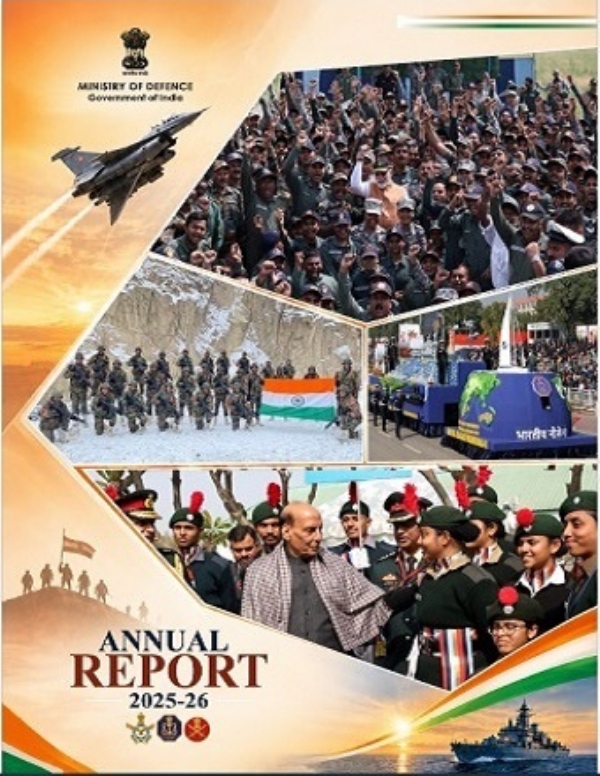
New Delhi, 14 September (H.S.): Although the border dispute did not figure in Prime Minister Narendra Modi’s bilateral meeting with Chinese President Xi Jinping during the latter’s visit to India for the BRICS Summit, the Defence Ministry’s annual report states that there has been a significant reduction in the deployment of Chinese troops along the Line of Actual Control (LAC). The report said that bilateral engagement between India and China at the political, diplomatic and military levels has led to positive developments along the northern borders. The Defence Ministry has also highlighted the role played by the Indian Air Force in Operation Sindoor.
The report was released a day after Chinese President Xi Jinping returned home from New Delhi following the BRICS Summit. In its annual report for 2025-26, the Defence Ministry said that the Indian Army had secured the northern borders. It added that mutual engagement between India and China at the political, diplomatic and military levels had contributed to improved relations and greater stability.
Describing the increased diplomatic and military engagement between the two countries, the report said both sides were seeking to resolve differences through partnership and peace rather than confrontation. It also stated that the deployment of Chinese troops along the northern border had declined considerably following India’s move to deploy 10 brigade-sized formations along the LAC and in training areas.
The annual report said the Indian Army remains well deployed across all sectors along the LAC and is fully prepared to respond to any sudden contingency. Describing the overall situation on the northern front in 2025, the Defence Ministry said various combat arms, including infantry, tanks, artillery and air defence, had been deployed under an integrated framework to operate independently and effectively in combat.
The report noted a significant reduction in the deployment of the People’s Liberation Army (PLA) across the northern border during 2025. It said renewed talks took place during the 33rd and 34th rounds of the Working Mechanism for Consultation and Coordination (WMCC), held in March and July 2025.
In addition, talks between the Special Representatives to resolve the India-China boundary question resumed this year, with two rounds held in December 2024 and August 2025. According to the report, Prime Minister Narendra Modi travelled to Tianjin, China, last August to attend the Shanghai Cooperation Organisation (SCO) Summit. Prior to that, President Xi Jinping had visited New Delhi for the BRICS Summit.
During the meeting between Modi and Xi on Saturday on the sidelines of the BRICS Summit, the two leaders discussed several issues, including reducing the trade deficit, addressing challenges such as terrorism and ensuring fair trade on multilateral platforms. The LAC issue, however, was not discussed during the meeting.
The Defence Ministry’s report also highlighted the Indian Air Force’s role in Operation Sindoor, stating that it carried out precision strikes against terrorist targets across Pakistan, including locations such as the Nur Khan and Rahim Yar Khan air bases. The Air Force also played a crucial role in protecting Indian airspace during retaliatory drone and UAV attacks.
As part of a layered air defence grid, indigenous Akash missile systems as well as Pechora and OSA-AK platforms were effectively deployed. The Integrated Air Command and Control System enabled real-time coordination, helping neutralise aerial threats and maintain network-centric operations throughout the conflict.
The Defence Ministry’s annual report also highlighted one of the longest-range surface-to-air engagements involving an S-400 unit. In one operation, a Pakistani special-mission aircraft was successfully engaged and destroyed from a distance of 314 kilometres. The operation demonstrated the effectiveness of India’s air-defence capabilities, with Indian radars tracking the threat accurately and without detection. A long-range surface-to-air missile was guided towards the target at an extended range.
The report said the operation demonstrated to the adversary that no location on land or in the air was beyond the reach of India’s air-defence capabilities.
Regarding Jammu and Kashmir, the report said the security situation in the Union Territory remained firmly under control due to the Army’s sustained efforts. It said people had chosen the path of development and were actively participating in government and Indian Army initiatives.
According to the report, this had contributed to a decline in violence, a reduction in protests and the absence of stone-pelting incidents. It added that the situation in Jammu and Kashmir and along the Line of Control (LoC) changed significantly during Operation Sindoor.
The report said that the situation stabilised to a considerable extent following Director General of Military Operations (DGMO)-level talks held on May 10 and 12, 2025, although a degree of uncertainty continues to persist.
---------------
Hindusthan Samachar / Jun Sarkar
18 Aug 2026